
Chemical Etching Graphite Fuel Cell Plates Animation
Graphite and graphite-composite materials are often preferred for fuel cell plates due to their superior corrosion resistance and high electrical conductivity. However, the true challenge lies in creating the “flow fields”—the intricate network of channels that guide hydrogen and oxygen across the membrane.
Traditional manufacturing often struggles with the brittle nature of graphite, making photochemical machining the preferred method for generating the high-density, complex patterns required for modern stacks.
What are Chemical Etched Graphite Plates?
In the context of fuel cells, these plates are ultra-thin, high-purity graphite or resin-impregnated graphite sheets that have been chemically “sculpted.” The etching process removes material from the surface to create precise channels, often in serpentine, parallel, or interdigitated patterns.
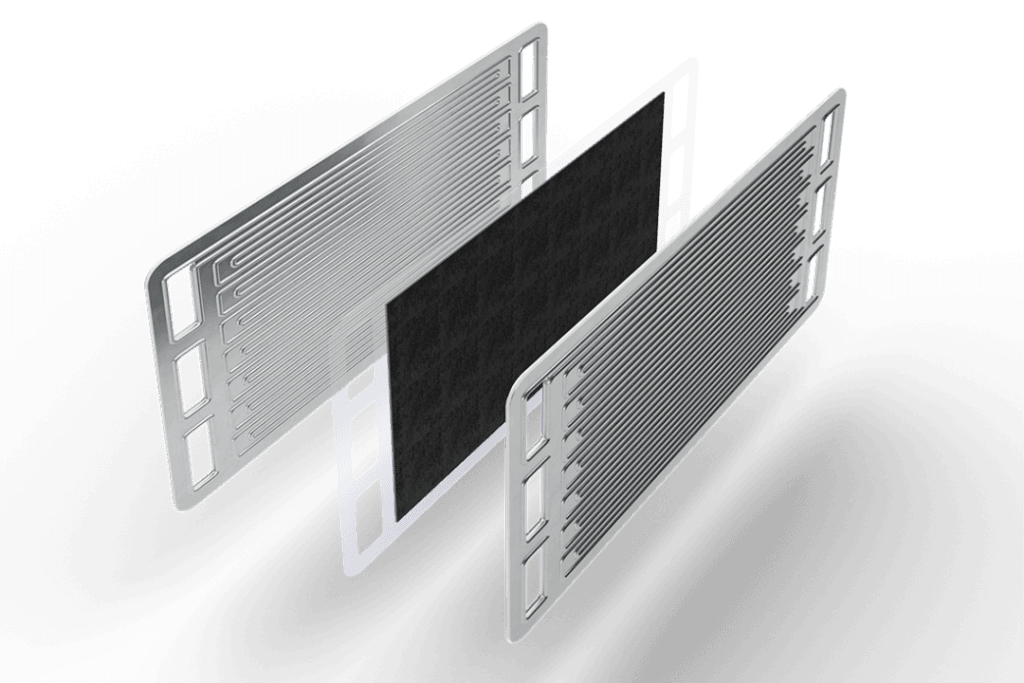
These flow field designs are essential for ensuring that reactant gases are distributed uniformly across the catalyst layer. Because the etching process is non-mechanical, it allows for the creation of these channels without micro-cracking the graphite substrate, preserving the structural integrity of the plate even at very low thicknesses.
Why is Chemical Etching Necessary for Graphite Plates?
Why move away from traditional mechanical methods? Graphite is famously difficult to machine without breakage or tool wear.
- Uniformity of Flow: Chemical etching allows for extremely consistent channel depths. If one channel is deeper than another, the gas will take the path of least resistance, leading to “dead zones” where no reaction occurs.
- Maintaining Surface Flatness: Mechanical milling can introduce localized stresses that cause thin graphite plates to warp. Etching removes material atom-by-atom, ensuring the plate remains perfectly flat for a gas-tight seal when the stack is compressed.
- Scalability of Complexity: Whether the design features 10 channels or 1,000, the etching process takes the same amount of time. This allows engineers to design incredibly complex, bio-inspired flow patterns that would be impossible to replicate with a CNC drill bit.
Process Comparison: Chemical Etching vs. CNC Milling
Choosing the right fabrication method is a balance between precision, material waste, and the risk of structural failure.
| Feature | Chemical Etching | CNC Milling | Compression Molding |
| Material Stress | Zero (Chemical) | High (Mechanical) | Moderate (Thermal/Pressure) |
| Minimum Wall Width | $0.1\text{ mm}$ | Generally $>0.5\text{ mm}$ | Variable |
| Channel Complexity | Unlimited | Restricted by Tool Radius | Limited by Mold Release |
| Surface Finish | Smooth/Consistent | Tool Marks/Burrs | Excellent |
| Prototype Cost | Low | High | Very High (Tooling) |
Technical Data and Precision Specifications
The efficiency of a fuel cell is directly proportional to the precision of its bipolar plates. Chemical etching provides the high-fidelity dimensions required to minimize “ohmic loss” and maximize power density.
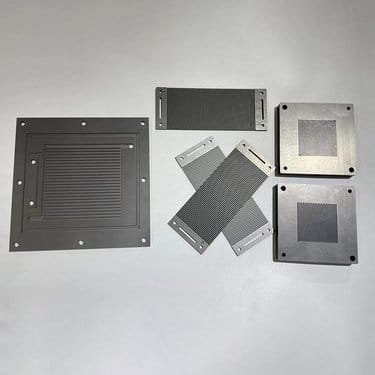
- Plate Thickness: $0.05\text{–}0.3\text{ mm}$ (Enabling ultra-compact, lightweight fuel cell stacks).
- Dimensional Tolerance: $\pm 0.01\text{ mm}$ (Ensuring exact volumetric flow rates across all channels).
- Channel Depth Consistency: Within $\pm 5\%$ of the target depth, critical for maintaining uniform pressure drops.
Critical Applications: From Heavy Duty to High Altitude
Chemical etched graphite plates are the backbone of high-performance fuel cell equipment across several specialized sectors:
1. Zero-Emission Transportation
The most prominent use is in Heavy-Duty Fuel Cell Trucks and Buses. These vehicles require plates that can withstand thousands of hours of vibration and thermal cycling without the flow fields degrading. The $0.3\text{ mm}$ plates allow for high power output without adding the weight penalty of traditional metal plates.
2. Stationary Power Generation
In Data Center Backup Power Units, graphite plates are used in large-scale stationary fuel cells. Because graphite does not leach metal ions (which can “poison” the fuel cell membrane), these etched plates ensure a lifespan of over $40,000\text{ hours}$ for critical infrastructure.
3. Aerospace and UAVs
For Hydrogen-Powered Drones (UAVs), weight is the primary constraint. Using chemical etching to produce plates as thin as $0.05\text{ mm}$ allows manufacturers to create “Goldilocks” stacks—light enough to fly for extended durations but robust enough to handle the pressures of pressurized hydrogen. Specifically, you will find these in High-Altitude Long-Endurance (HALE) aircraft and Portable Electrolyzer Units used for on-site fuel generation.
By integrating chemical etching into the graphite production line, manufacturers can achieve the “impossible” geometry required to make hydrogen a viable, everyday fuel source.
Chemical etching machine