Cobalt Chemical Etching — Engineering Reference
Wet chemical etching of Cobalt is a precision subtractive process that defines fine features by selectively dissolving the metal through a photoresist-patterned mask. On Cobalt specifically, the etchant choice, bath temperature, and conveyor speed combine to set the etch factor, undercut, and yield envelope every production run lives in.
Why Wet Chemical Etching for Cobalt?
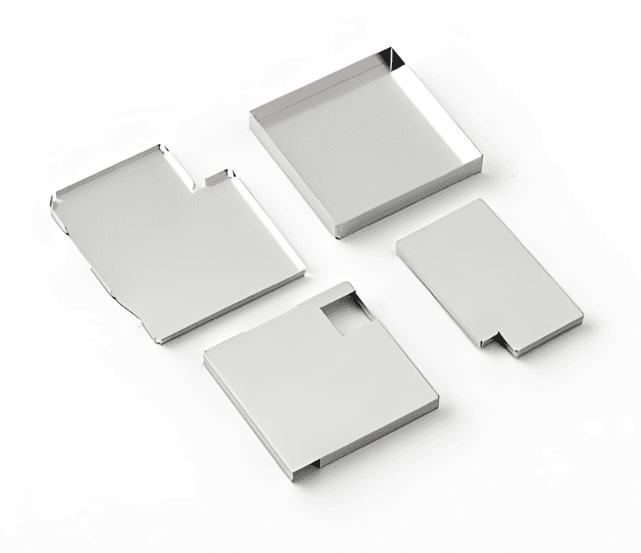
Compared to laser, stamping, or wire EDM, wet chemical etching imparts no mechanical or thermal load to Cobalt. The process is parallel — every feature on a sheet etches simultaneously — so feature count has no impact on tooling cost. For Cobalt parts with hundreds or thousands of micro-features per piece, that is the dominant economic argument.
- Burr-free, stress-free edges — no post-deburring on Cobalt required.
- Tooling cost flat with feature complexity — only the photomask changes.
- Fast prototype iteration — artwork edits, not tool re-cuts.
- Tight tolerance on thin gauge Cobalt (down to ±25 μm in production).
- Compatible with downstream passivation, plating, electropolishing.
Process Window for Cobalt
Production lines etching Cobalt run a closed-loop temperature band of typically ±1.5 °C, with bath specific gravity monitored each shift via hydrometer or refractometer. Conveyor speed inversely tracks sheet thickness: thinner stock runs faster, thicker stock slower, with the goal of holding etch factor (EF) above 2.5 and single-side undercut below thirty microns wherever possible. For Cobalt, the recommended chemistry is FeCl₃+HCl.
| Recommended etchant | FeCl₃+HCl |
|---|---|
| Bath temperature window | 40 – 55 °C (chemistry-dependent) |
| Specific gravity setpoint | 1.30 – 1.45 g/cm³ for ferric chloride systems |
| Conveyor speed range | 0.4 – 8.0 m/min (thickness-dependent) |
| Typical etch factor (EF) | 2.5 – 3.0 |
| Single-side undercut | 5 – 40 μm depending on depth and thickness |
| Minimum hole diameter | ≈ 1.2× sheet thickness |
| Minimum line width | ≈ 1.0× sheet thickness |
| Mass-production yield | 95 – 99% on mature recipes for Cobalt |
Common Applications for Chemically Etched Cobalt
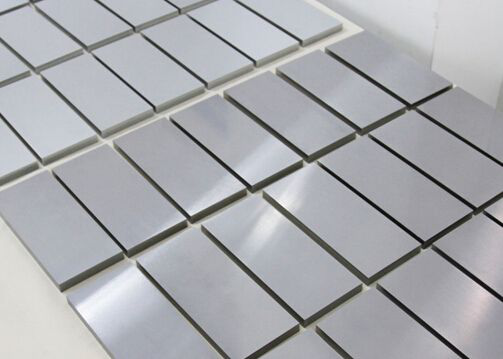
Across the markets we serve, chemically etched Cobalt is most often deployed in filtration meshes, lead frames and connector blanks, surgical and consumer blades, EMI shielding gaskets, heat-dissipation vents, and decorative architectural pieces. Thickness and feature complexity push different applications onto different recipes.
Related Recipes & Process Parameters
Every formula and parameter row below is a live page on this site with the full chemistry, conveyor speed, and tolerance window for the exact material-thickness-etchant combination. These are the references our process engineers cite from on production shifts.
Related Material References
Related Production Applications
Related Process Equipment
Frequently Asked Questions
How is bath chemistry maintained over a production shift on Cobalt?
The FeCl₃+HCl bath is titrated at shift start and replenished with concentrated stock + water based on specific-gravity drift. Spent bath is regenerated electrolytically where possible.
Is Cobalt chemical etching suitable for medical or aerospace parts?
Yes. The process produces stress-free, burr-free parts with no recast layer — exactly the surface condition required by medical, aerospace, and high-reliability applications using Cobalt.
What edge quality can I expect when etching Cobalt?
Wet chemical etching is non-contact, so etched Cobalt parts are completely burr-free, stress-free, and free of any heat-affected zone. Final edge cleanliness depends on photoresist adhesion and rinse cascade discipline.
Which etchant works best for Cobalt?
The recommended starting chemistry is FeCl₃+HCl. It balances etch rate, bath stability, and photoresist compatibility for Cobalt across the production thickness range.
Frequently Asked Questions
Which industries use Wet Chemical Etching Cobalt?
Wet Chemical Etching Cobalt is used across electronics, medical, automotive, aerospace and industrial filtration — anywhere precise, burr-free thin-metal parts are required.
What is Wet Chemical Etching Cobalt and how is it made?
Wet Chemical Etching Cobalt is produced by photochemical etching — a process that uses a patterned resist and etchant to remove metal precisely, with no mechanical stress or burrs.
What tolerances can you achieve for Wet Chemical Etching Cobalt?
Photochemical etching holds tight, repeatable tolerances on thin metal, which makes it well suited to Wet Chemical Etching Cobalt. Exact figures depend on material and thickness.