
Phosphor Bronze is the “marathon runner” of the alloy world. Known for its superior fatigue resistance and high elasticity, it is the ideal material for components that must flex and rotate millions of times without snapping. However, the very properties that make it durable—its hardness and spring-like nature—make it a nightmare to stamp or cut with traditional tools.
What are Chemical Etching Robust Drive Bands?
A robust drive band is a high-tensile metal strip used in pulley systems to transmit torque with zero backlash. When we specify “chemically etched” bands, we are referring to a subtractive manufacturing process that uses acid to dissolve unwanted metal at the molecular level.
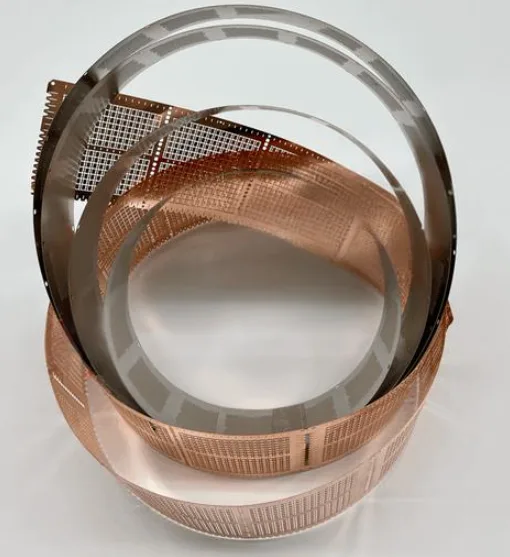
Unlike mechanical cutting, Photochemical Machining (PCM) creates these bands without ever touching the metal with a blade or a die. This results in a part that is perfectly flat and free of the microscopic fractures that usually lead to mechanical failure in high-torque environments.
Why Do We Need Chemical Etching?
If you are building a system that requires extreme repeatability—like a robotic arm or a satellite gimbal—traditional manufacturing methods actually introduce “weak points” into your design.
- Elimination of Edge Stress: Stamping a drive band creates a “shear and break” edge that acts as a starting point for cracks. Etching produces a smooth, burr-free edge that preserves the long-term fatigue life of the Phosphor Bronze.
- No Heat-Affected Zones (HAZ): Laser cutting generates intense heat that can “anneal” or soften the Phosphor Bronze, destroying its spring-like properties. Etching is a room-temperature process that keeps the alloy’s temper exactly as intended.
- Perfect Flatness: High-torque bands must sit perfectly flush against pulleys. Mechanical processes can “oil-can” or warp thin metal. Etching removes material uniformly, ensuring the band remains dead-flat for maximum surface contact.
Process Comparison: Chemical Etching vs. Stamping vs. Laser
When reliability is the priority, the manufacturing method is just as important as the material itself.
| Feature | Chemical Etching | Hard Tool Stamping | Laser Cutting |
| Edge Stress | Zero | High (Mechanical) | Moderate (Thermal) |
| Tooling Cost | Low (Digital) | High (Steel Dies) | Zero |
| Precision | Ultra-High | Moderate | High |
| Material Temper | Unchanged | Unchanged | Softened at Edges |
| Lead Time | Days | Weeks | Hours/Days |
Technical Data: The Engineering Standard
To ensure these bands can handle the “snap” of high-torque starts and stops, we maintain the following rigorous production standards:
- Tolerance: ±0.01 mm (Ensuring zero-backlash performance and perfect pulley alignment).
- Thickness Range: 0.05 mm to 0.3 mm (Optimized for the perfect balance of flexibility and tensile strength).
- Surface Finish: Maintained at original mill-spec to ensure consistent friction coefficients during torque transmission.
Critical Applications: Where Precision Drives Performance
Chemical Etching Phosphor Bronze Drive Bands are utilized in high-stakes equipment where gear-slippage or belt-stretch is unacceptable.
1. Robotic Surgical Systems
In devices like the Da Vinci Surgical System, etched drive bands translate the surgeon’s hand movements into the micro-motions of the robotic instruments. The ±0.01 mm tolerance ensures there is no “lag,” providing the tactile feedback necessary for delicate procedures.
2. Satellite Positioning Gimbals
Spacecraft use drive bands to rotate solar arrays and communication antennas. These bands must operate in a vacuum without lubrication. Phosphor Bronze is naturally low-friction, and the etched edges ensure the band doesn’t snag or fray over a 15-year mission.
3. High-Speed Pick-and-Place Machines
In semiconductor assembly, machines must move at blinding speeds with sub-micron accuracy. Etched drive bands are used in the X-Y Linear Actuators of these machines. Because the bands are stress-free, they don’t stretch over time, keeping the machine calibrated even after billions of cycles.
4. Precision Optical Scanners
High-end LIDAR Units and Wide-Format Scanners use these bands to move lenses and sensors. The absence of burrs on the etched band ensures a smooth, silent motion that prevents “jitter” in the resulting data or imagery.
Matched to this application by our engineering team. Configuration is confirmed against your part and volume.
Frequently Asked Questions
Which metals can be used for Chemical Etching Phosphor Bronze Drive Bands – High Torque Transmission?
What lead time should I expect for Chemical Etching Phosphor Bronze Drive Bands – High Torque Transmission?
How does etching compare with stamping or laser cutting for Chemical Etching Phosphor Bronze Drive Bands – High Torque Transmission?
Can you handle both prototype and production volumes for Chemical Etching Phosphor Bronze Drive Bands – High Torque Transmission?
Sources & References
- ASTM E407: Standard Practice for Microetching Metals and Alloys
- ASTM B912: Standard Specification for Passivation of Stainless Steels
- Photo Chemical Machining Institute — process capability guidelines
- NIST Engineering Statistics Handbook — process tolerance and capability
Standards are referenced for context. Always confirm parameters against the current published edition and your own process validation.