
Precision Chemical Etching: Spring Steel Shutter Blades Animation
Spring steel is the “gold standard” for components requiring high yield strength and the ability to return to an original shape after significant deflection. However, traditional machining of such a hard material often introduces microscopic defects that lead to premature failure. This is why Chemical Etching has become the critical pathway for producing high-performance optical apertures.
What are Chemical Etching Robust Shutter Blades?
A “Robust” shutter blade or slit aperture is an ultra-thin component designed to regulate light or particle beams with extreme repeatability. Unlike standard hardware, these parts are often manufactured from high-carbon spring steel to ensure they can withstand high-frequency mechanical cycling.
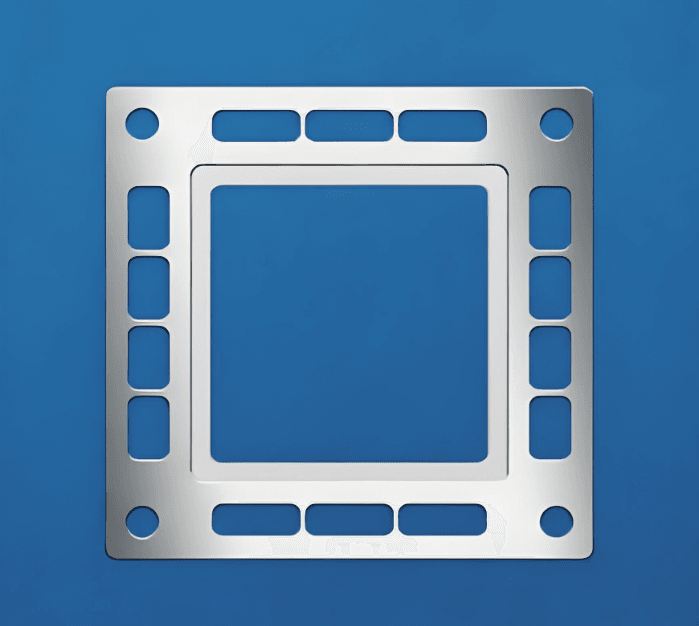
In the chemical etching process, the geometry of the shutter—including the critical slit aperture—is defined by a digital tool and then “dissolved” into existence. Because this process is non-contact, the spring steel retains its full temper and flat profile, creating a part that is inherently more “robust” than its stamped or laser-cut counterparts.
Why Do We Need Chemical Etching?
If you are designing a high-end optical system, the “Why” behind chemical etching comes down to physics:
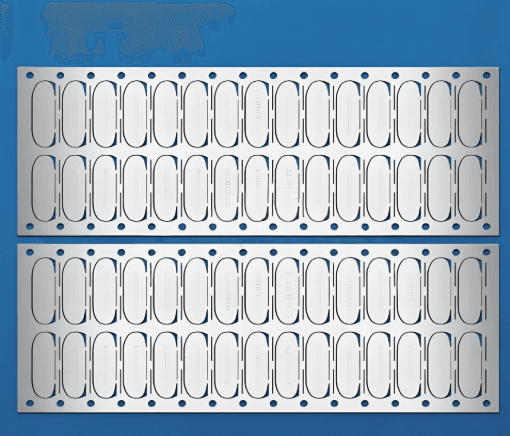
- Zero Edge Stress: Traditional mechanical cutting creates microscopic “notches” at the edge of the steel. In a high-speed shutter, these notches act as stress concentrators where cracks eventually form. Etching produces a smooth, stress-free edge that dramatically extends the cycle life of the part.
- Optical Purity (No Burrs): Any burr on the edge of a slit aperture will cause stray light and diffraction. Chemical etching removes material atom-by-atom, ensuring the aperture edges are perfectly clean and sharp, which is essential for maintaining signal-to-noise ratios in sensors.
- Flatness Retention: Spring steel is sensitive to heat. Other processes can “oil-can” or warp the material, but etching remains at room temperature, ensuring the blade stays perfectly flat for high-speed movement within narrow housings.
Process Comparison: Chemical Etching vs. Laser Processing
While laser cutting is a common tool for metal fabrication, it often falls short when dealing with the delicate thin-gauge requirements of optical shutters.
| Feature | Chemical Etching | Laser Cutting | Stamping |
| Edge Quality | Perfectly smooth | Melted/Heat-affected | Sheared/Deformed |
| Material Hardness | No change | Potential local softening | No change |
| Burrs | Completely burr-free | Slag/Dross at edges | Significant burrs |
| Precision | Ultra-High | High (but heat-limited) | Moderate |
| Part Flatness | Excellent | Risk of thermal bowing | Risk of mechanical warp |
Technical Data and Precision Metrics
Precision in slit apertures is non-negotiable. To achieve the necessary manufacturing accuracy, we utilize the following parameters:
- Material Thickness: $0.05+-0.3 mm (Providing the perfect balance of low mass for speed and high strength for durability).
- Dimensional Tolerance: +-0.01mm (Crucial for the exact calibration of light exposure or particle flow).
- Surface Finish: Maintained at a matte or polished state, often ready for specialized optical coatings to further reduce reflection.
Critical Applications: Precision in Every Field
Chemical Etching Spring Steel components are integrated into the “eyes” and “ears” of modern technology, specifically in environments where mechanical failure is not an option.
1. Remote Sensing and Space Exploration
In Space-borne LiDAR Systems and Multi-spectral Imagers, shutter blades are used to protect sensitive detectors from direct sunlight or to calibrate laser pulses. These parts must survive the vibration of launch and then operate for years in a vacuum. The stress-free nature of etched steel ensures they don’t crack under the extreme thermal cycling of orbit.
2. Medical Diagnostic Imaging
You will find these precision slit apertures inside X-ray Beam Collimators and Confocal Microscopes. In medical imaging, the aperture must be perfectly precise to define the area of radiation or light exposure, ensuring high-resolution results for patient diagnosis while protecting surrounding tissue.
3. Analytical Instrumentation
In Spectrometers and Mass Spectrometry Equipment, etched spring steel slits act as the “gatekeepers” for light or ions. By maintaining a tolerance of +-0.01mm, these slits ensure that only the specific wavelengths or particles desired reach the optical sensors, allowing for the detection of substances at the parts-per-billion level.
By choosing chemical etching for spring steel shutter blades, you aren’t just selecting a manufacturing method—you are ensuring the longevity and precision of your entire optical assembly.
Matched to this application by our engineering team. Configuration is confirmed against your part and volume.
Frequently Asked Questions
What lead time should I expect for Chemical Etching Spring Steel Shutter Blades – Precision Slit Apertures?
What tolerances are achievable for Chemical Etching Spring Steel Shutter Blades – Precision Slit Apertures?
How does etching compare with stamping or laser cutting for Chemical Etching Spring Steel Shutter Blades – Precision Slit Apertures?
Can you handle both prototype and production volumes for Chemical Etching Spring Steel Shutter Blades – Precision Slit Apertures?
Sources & References
- ASTM E407: Standard Practice for Microetching Metals and Alloys
- ASTM B912: Standard Specification for Passivation of Stainless Steels
- Photo Chemical Machining Institute — process capability guidelines
- NIST Engineering Statistics Handbook — process tolerance and capability
Standards are referenced for context. Always confirm parameters against the current published edition and your own process validation.