

Wet Chemical Etching Machine
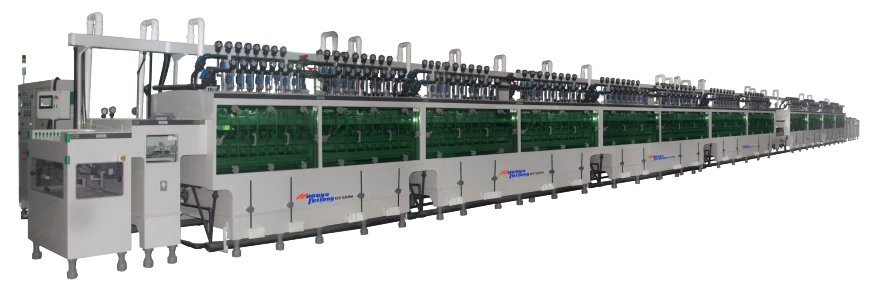
Production-grade wet chemical acid etching machine that sprays etchant across copper-clad laminate, aluminum substrate, or stainless steel plate to dissolve the exposed metal and reveal a patterned circuit, mesh, or precision part. Each line is configured to the customer’s production capacity — single-stage development, three-in-one developing + etching + film-removal, or fully integrated photoresist-coater + UV-exposure + etch + strip cells are all available.
Why This Equipment
- Customized to your production capacity — every line is built around the customer’s panel size and throughput target, not sold as a one-size-fits-all SKU.
- Process library backed by an in-house etching factory — every chemistry shipped has been proven on our own production runs first.
- Closed-loop bath chemistry with SG, pH, and temperature feedback to the replenishment manifold.
- Independent top and bottom spray nozzle banks for true double-sided through-etching uniformity.
- Sheet-by-sheet traceability — bath conditions and conveyor speed logged per panel for QA.
Engineering Specifications
| Etching precision | 0.0028 mm (industry-leading on production-grade lines) |
|---|---|
| Process modes | Spray etching · immersion · combined; double-sided nozzle banks standard |
| Compatible substrates | Copper-clad laminate, aluminum, stainless steel, nickel, brass, titanium, refractory metals |
| Compatible chemistries | FeCl₃ · FeCl₃+HCl · HCl+H₂SO₄ · HNO₃ · cupric chloride · alkaline etchant |
| Control system | Industrial PLC + HMI, recipe storage, remote telemetry; real-time SG / pH / temperature logging |
| Wetted parts | PVC, PVDF, or Hastelloy C-276 per chemistry build option |
| Optional integration | Photoresist coater, UV exposure, developer, etch, and film-removal in one line (“3-in-1” or “5-in-1”) |
| Line length | 12 – 25 m typical for full production line |
| Compliance | CE / UL / SEMI S2 + S8 available as engineering options |


Design Priorities & Process Discipline
The platform is engineered to four priorities: bath chemistry stability, conveyor uniformity, spray-pressure uniformity, and rinse cascade discipline. In practice it is the temperature loop and the spray nozzles that move output yield from 95% to 98%; everything else is supporting infrastructure.
- Closed-loop bath chemistry — SG and pH sensors feed a replenishment manifold.
- Dual-bank nozzles — independent top and bottom spray for double-sided etching uniformity.
- Conveyor traceability — sheet-by-sheet ID logged with bath conditions for QA.
- Acid-resistant wetted parts — PVC, PVDF, or Hastelloy C-276 depending on chemistry.
- Energy recovery — heat exchanger between hot rinse exit and cold feed water reduces line steam demand.
Request Quote / Layout Drawing Browse Process Library Search Parameter Database
Related Recipes & Process Parameters
Every formula and parameter row below is a live page on this site with the full chemistry, conveyor speed, and tolerance window for the exact material-thickness-etchant combination. These are the references our process engineers cite from on production shifts.
Related Material References
Related Production Applications
Related Process Equipment
Frequently Asked Questions
What materials can this machine handle?
This machine is engineered for the material coverage cited in the specification table above. Bath chemistry and wetted parts are selected at build time to match the customer’s actual metal and process mix.
What support is offered after delivery?
Standard packages include on-site commissioning, operator training, and one year of remote process support. Spare-parts kits and bath-titration consumables are quoted separately.
Are CE / UL / SEMI compliance packages available?
Yes. Compliance packages are available as engineering options. Specify at order time so wetted parts, electrical, and emergency-stop circuits are sized accordingly.
What is the typical lead time from order?
Production lead time is typically 8 – 14 weeks depending on configuration. Plug-and-play bench units are usually available faster.
Frequently Asked Questions
What workpiece sizes does the Wet Chemical Etching Processing Equipment – Wet Chemical Etching Machine handle?
What does the Wet Chemical Etching Processing Equipment – Wet Chemical Etching Machine do in the production line?
Can the Wet Chemical Etching Processing Equipment – Wet Chemical Etching Machine be customised for our process?
What materials is the Wet Chemical Etching Processing Equipment – Wet Chemical Etching Machine suitable for?
Sources & References
- ASTM E407: Standard Practice for Microetching Metals and Alloys
- IPC-A-600: Acceptability of Printed Boards
- Photo Chemical Machining Institute — process capability guidelines
- NIST Engineering Statistics Handbook — process tolerance and capability
Standards are referenced for context. Always confirm parameters against the current published edition and your own process validation.