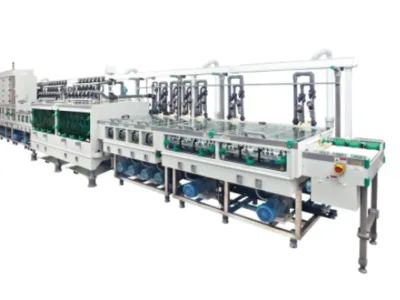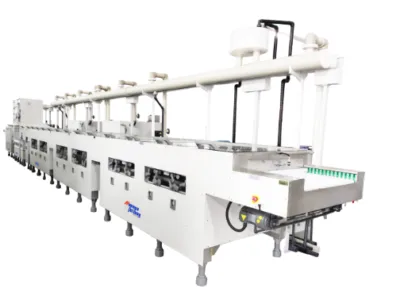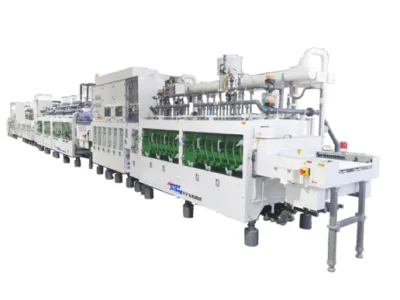
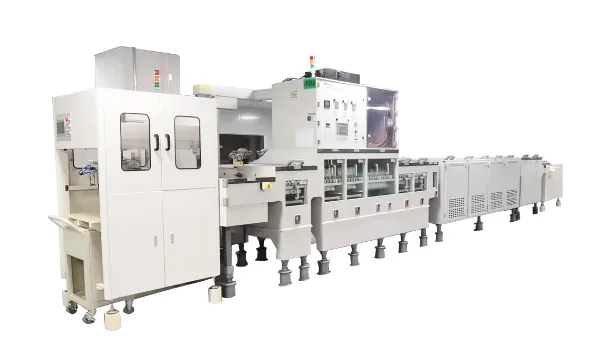
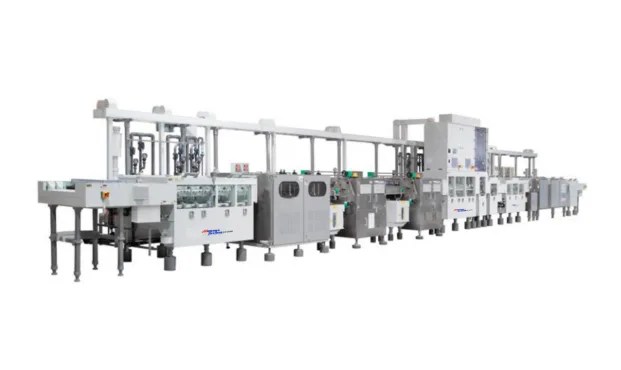
Metal & PCB Chemical Cleaning Machine
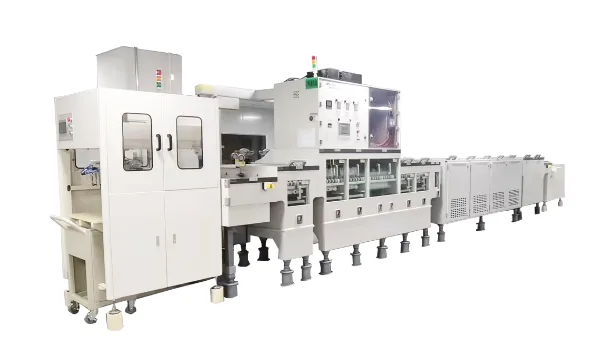
Production-grade chemical cleaning machine for pre-etch surface activation and post-etch finish preparation. Combines oil removal, mild pickling, and a deionized-water final rinse into a single conveyorized line. The compact 7.8-meter footprint and 33 kW motor / 16 kW heater specification make it the lowest-utility-cost cell in a typical wet processing line — yet it is the cell that determines downstream plating adhesion and final yield.
Why This Equipment
- Three-stage cleaning in one pass — oil removal, pickling, DI rinse — replaces three standalone tanks.
- DI-water final rinse — no mineral residue on the dried panel; critical for downstream coating/plating adhesion.
- Compact footprint (under 8 m) — fits as an in-line cell in space-constrained shops without sacrificing process completeness.
- Low utility cost — 33 kW + 16 kW is half the power draw of an SES or DES line, making this the most cost-efficient cleaning cell to operate.
- Cross-material compatibility — same bath topology serves stainless, copper, aluminum, and titanium families.
Engineering Specifications
Where This Equipment Fits in the Production Line
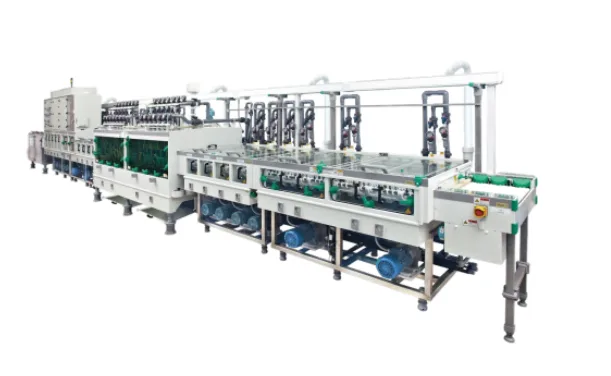
Chemical cleaning can sit either BEFORE etching (surface activation) or AFTER stripping (final finish). In high-yield production lines we recommend running it BOTH places — front cleans the incoming sheet, back cleans the etched panel before plating or coating. Pairs naturally with the Precision Acid Cleaning Machine for tougher oxide jobs.
Request Quote & Layout Browse Process Library Search Parameter Database
Related Equipment in This Production Line
Related Recipes & Process Parameters
Every formula and parameter row below is a live page on this site with the full chemistry, conveyor speed, and tolerance window for the exact material-thickness-etchant combination. These are the references our process engineers cite from on production shifts.
Related Material References
Related Production Applications
Related Process Equipment
Frequently Asked Questions
What is included in commissioning?
On-site installation supervision by our engineering team, full mechanical and electrical commissioning, recipe loading and validation against three reference panel formats, operator training (typically 3–5 days), and one year of remote process support.
What is the warranty?
Standard one-year warranty against manufacturing defects, plus lifetime maintenance support — spare parts are stocked and shipped from Shenzhen on order.
Are CE / UL / SEMI compliance packages available?
Yes. CE, UL listing, and SEMI S2 / S8 compliance packages are engineering options. Specify at order time so wetted parts, electrical, and safety circuits are sized accordingly. Compliance documentation accompanies the equipment at delivery.
Why DI water for the final rinse?
Tap water leaves Ca / Mg / Cl mineral residue when it evaporates from the panel surface. Those mineral spots become adhesion failure sites under downstream coating or plating. Final-stage DI rinse removes them, so the panel goes to the next process with a clean, ion-free surface.
Frequently Asked Questions
Can the Metal & PCB Chemical Cleaning Machine be customised for our process?
What does the Metal & PCB Chemical Cleaning Machine do in the production line?
What level of automation does the Metal & PCB Chemical Cleaning Machine offer?
What materials is the Metal & PCB Chemical Cleaning Machine suitable for?
Sources & References
- IPC-A-600: Acceptability of Printed Boards
- IPC-6012: Qualification and Performance Specification for Rigid Printed Boards
- Photo Chemical Machining Institute — process capability guidelines
- NIST Engineering Statistics Handbook — process tolerance and capability
Standards are referenced for context. Always confirm parameters against the current published edition and your own process validation.