
C1100 T2 copper · FeCl₃
Chemical Etching Formula
C1100 T2 copper
with FeCl₃
Formula Summary
The table below summarizes every parameter that defines this etching formula. Values listed as ranges scale with sheet thickness across the supported band.
Why FeCl₃ for C1100 T2 copper?
On C1100 T2 copper, the ferric chloride system attacks the alloy's oxide layer continuously while ferric ions drive dissolution. It is regenerable, compatible with standard photolithography, and produces clean burr-free edges — which is why nearly every C1100 T2 copper etch line runs a variant of this formula.
Process Window & Bath Control
The process window for this FeCl₃ formula centres on 46°C and 36 °Bé. Conveyor speed spans 30.07 m/min over the 0.01 mm thickness band; the typical operating point is 30.07 m/min. Every 5°C drop in bath temperature requires roughly a 30% reduction in conveyor speed to hold the same etch depth, so temperature stability is the single biggest lever on consistency.
Design Rules & Tolerances
Feature sizes scale with sheet thickness. For this formula the minimum hole diameter ranges 15 μm and the minimum line width ranges 100 μm across the 0.01 mm band, following the industry 1.2× (hole) and 1.0× (line) thickness rules. Single-side undercut ranges 2 μm, and the etch factor is about 2.82. Size your photomask by subtracting twice the expected undercut from each finished feature dimension.
• Minimum hole diameter range: 15 μm
• Minimum line width range: 100 μm
• Single-side undercut range: 2 μm
• Typical etch factor (EF): 2.82
Yield & Production Economics
Expect a yield in the 98.5% range for C1100 T2 copper with FeCl₃, with 98.5% typical on a well-controlled line. Most rejects trace back to upstream coating and exposure rather than to the etch bath itself, so tightening photolithography control is usually the fastest path to a higher number.
Typical Applications
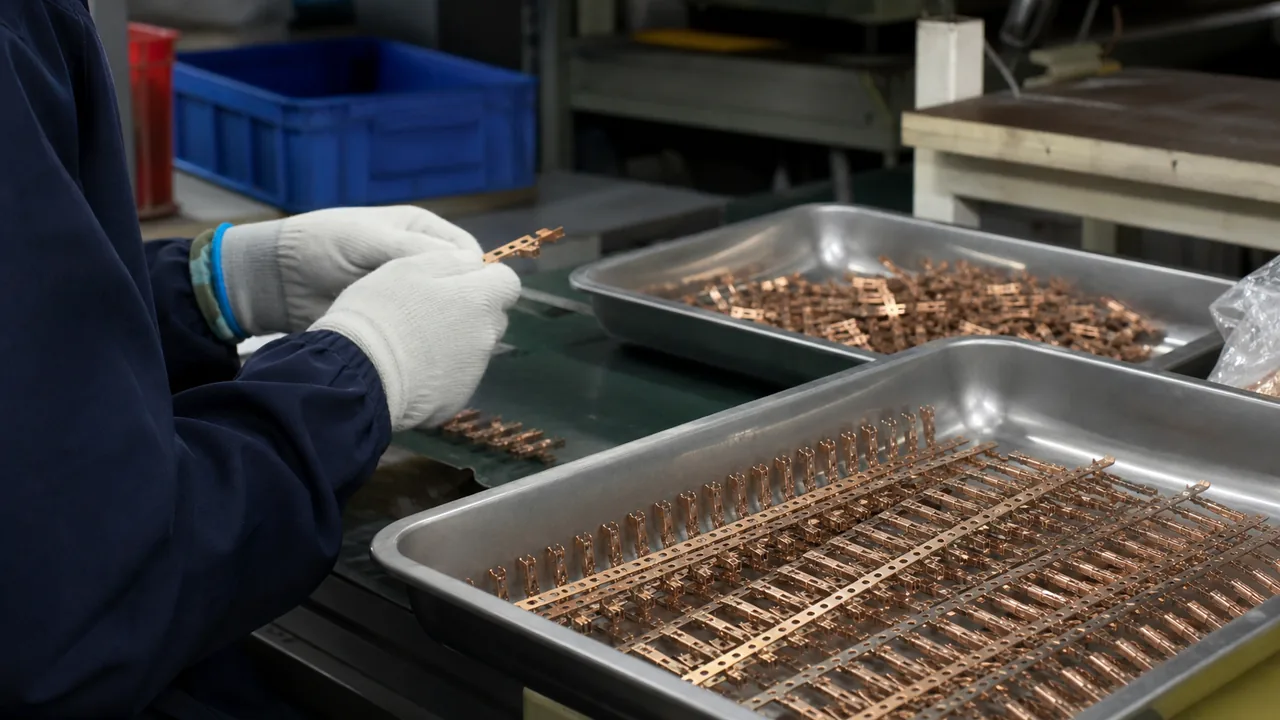
Parts produced with the FeCl₃ formula on C1100 T2 copper are common in lead frames, busbars, flexible heater elements, RF gaskets, and precision electrical contacts. The burr-free, stress-free nature of chemical etching makes it the preferred process wherever flatness and edge quality matter more than raw throughput.
Process Equipment & Material Reference
Process equipment for the C1100 T2 copper / FeCl₃ combination is built around our wet chemical etching machine platform — closed-loop temperature control, redundant pump headers, and metering for bath replenishment all directly affect the etch factor and yield numbers cited on this page.
The Copper chemical etching guide reference goes one level above the recipe shown here, surveying the full thickness range, depth options, and common subgrades we run for copper.
Production Use Cases for This Formula
Parts produced with this C1100 T2 copper + FeCl₃ formula end up in a wide range of finished products. Representative production runs we have completed using this exact recipe family include mobile-phone earpiece mesh, high-precision etched lead frames, and electronic thin-film component etching. Each case shares the same root sensitivity: clean photoresist edges, a tightly held bath SG of 1.340, and a conveyor speed inside the 30.07 m/min envelope.
Designs that sit slightly outside this thickness or feature-size envelope are usually addressable by a sister formula in the same etchant family. The bath chemistry stays the same; the tuning shifts to conveyor speed and resist choice.
More Copper & Brass Formulas
Other formulas in the same material family.
Frequently Asked Questions
Sources & References
- ASTM E407: Standard Practice for Microetching Metals and Alloys
- ASTM B912: Standard Specification for Passivation of Stainless Steels
- Photo Chemical Machining Institute — process capability guidelines
- NIST Engineering Statistics Handbook — process tolerance and capability
Standards are referenced for context. Always confirm parameters against the current published edition and your own process validation.
Need a Quote for This Process?
WET Etched runs production wet chemical etching lines using the FeCl₃ chemistry. Send us your part drawing and quantity for a full process quote.