
Precision Encoder Disk Manufacturing & Applications
| Category | Sub-Category | Key Details | Equipment / Tools Used |
|---|---|---|---|
| Material | Base Material | 304 or 316 stainless steel, thickness 0.1–1.5 mm | Uncoiler, tension leveler, ultrasonic cleaning line |
| Manufacturing Process | 1. Cleaning | Removal of oils, particles, and oxidation | Ultrasonic cleaning tanks, deionized water rinses, air knives |
| 2. Photoresist Application | Dry-film photoresist applied for consistent thickness | Hot roll laminator, automated cut-sheet feeder | |
| 3. UV Exposure | Pattern transfer from phototool to resist | Double-sided UV exposure frame, vacuum frame, collimator, mercury vapor/LED UV lamps | |
| 4. Development | Removal of unexposed resist to reveal metal pattern | Conveyorized spray developer, sodium carbonate solution, drying oven | |
| 5. Chemical Etching | Dissolution of exposed stainless steel; double-sided etching for precision | Conveyorized etcher with oscillating spray nozzles, ferric chloride (FeCl₃), etchant regeneration system | |
| 6. Resist Stripping | Removal of remaining photoresist | Conveyorized stripper with sodium hydroxide (NaOH) solution, high-pressure rinses, plasma cleaner (optional) | |
| 7. Inspection & QA | Verification of line width, concentricity, defects | Automated optical inspection (AOI), vision measurement machine (VMM), high-resolution microscope | |
| Applications & End Equipment | Industrial Automation | Position and speed feedback for motion control | Servo motors, CNC machines, robotic arms (collaborative & industrial), linear actuators, pick-and-place systems |
| Semiconductor Manufacturing | Ultra-precise wafer positioning and inspection | Wafer steppers/scanners, SEMs, optical inspection tools, die attach & wire bonders | |
| Medical & Life Sciences | Sterile, reliable feedback for surgical and diagnostic equipment | Surgical robots, CT scanners, MRI patient positioning systems, automated liquid handling platforms | |
| Aerospace & Defense | High-reliability feedback in extreme environments | Flight control actuators (EHA/EMA), inertial navigation systems (INS), satellite solar array drives, antenna pointing mechanisms | |
| High-End Metrology | Precision angular and linear measurement | Direct drive rotary tables, coordinate measuring machines (CMMs), laser scanners, 3D imaging systems |
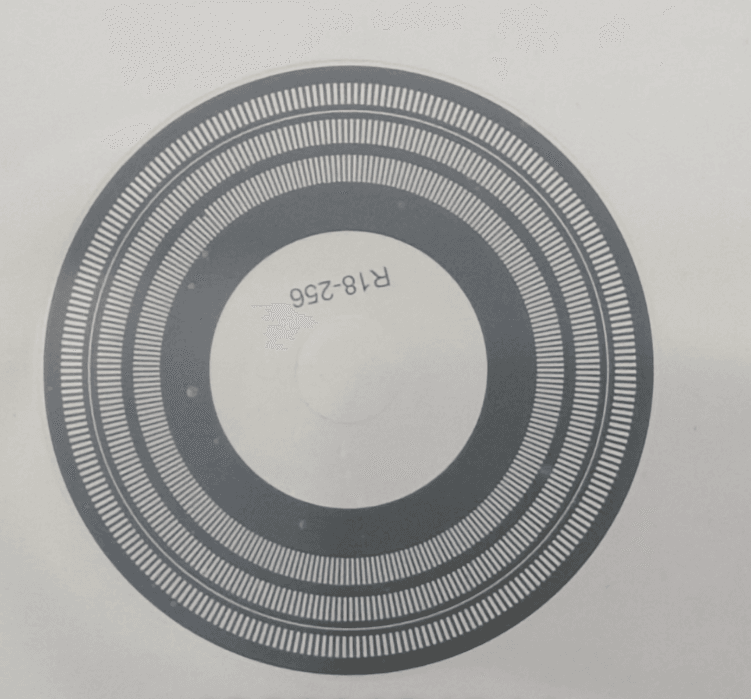
Part 1: The Fabrication Process of Precision Encoders
The production of precision stainless steel incremental encoder disks via chemical etching is a meticulously controlled, multi-stage process. Each step is designed to maintain the integrity of the grating pattern, ensuring consistent signal fidelity.
Step 1: Material Preparation and Cleaning
The process begins with the selection of the base material. For high-precision applications, 304 or 316 stainless steel is typically chosen for its corrosion resistance, magnetic properties (for Hall-effect sensors), and mechanical stability. The material is supplied in coils or sheets with precisely controlled thicknesses, often ranging from 0.1 mm to 1.5 mm, depending on the encoder’s inertia and resolution requirements.
- Equipment Used:
- Uncoiler and tension leveler: To flatten the raw stock and remove residual stress.
- Ultrasonic cleaning line: A series of tanks containing alkaline detergents, deionized water rinses, and air knives to remove oils, particulates, and oxidation layers. Surface cleanliness is critical for photoresist adhesion.
Step 2: Lamination or Photoresist Coating
A uniform layer of photoresist is applied to both sides of the cleaned stainless steel sheet. For high-volume production of encoder disks, dry-film photoresist is preferred due to its thickness consistency and ability to cover fine features without edge bead buildup. This resist acts as a stencil, protecting the metal that will form the grating bars from the etchant.
- Equipment Used:
- Hot roll laminator: Applies the dry-film photoresist under controlled heat and pressure. For double-sided etching (required for through-hole gratings), both sides are laminated simultaneously.
- Automated cut-sheet feeder: If the process uses sheet-fed rather than roll-to-roll handling.
Step 3: UV Exposure (Photolithography)
The coated metal is transferred to a cleanroom environment (Class 10,000 or better) to prevent particulate defects. The pattern of the incremental encoder—consisting of alternating transparent and opaque lines (the grating)—is transferred from a phototool to the photoresist using ultraviolet (UV) light.
The phototool is a high-precision film or glass mask containing the encoder pattern. For incremental disks, this pattern includes the incremental track (a series of radial lines for position and speed detection) and often a reference/index track (a single slot or pattern for home positioning). The critical feature sizes, such as line width and spacing (pitch), can be as fine as 20 microns or less.
- Equipment Used:
- Double-sided UV exposure frame: A vacuum frame that holds the phototool in intimate contact with the resist-coated metal. UV lamps (mercury vapor or LED arrays) emit light at 365 nm or 405 nm to polymerize the exposed areas.
- Collimator: Ensures the UV light rays are parallel, preventing undercutting of fine features during exposure.
Step 4: Development
After exposure, the unexposed (or exposed, depending on whether a positive or negative resist is used) areas of the photoresist are washed away. This reveals the bare stainless steel in the pattern of the encoder gratings.
- Equipment Used:
- Developing line: A conveyorized spray processor using a sodium carbonate (Na₂CO₃) solution for dry-film resists. The machine includes spray manifolds, rinse sections, and a drying oven. Precise control of temperature (typically 25–30°C) and conveyor speed ensures complete development without damaging fine features.
Step 5: Chemical Etching
This is the core process where the exposed stainless steel is dissolved. The developed panels are passed through an etcher that sprays a heated etchant solution—typically ferric chloride (FeCl₃) —under high pressure onto both sides of the material. Because etching occurs simultaneously from both sides, the process achieves a nearly vertical sidewall profile with minimal undercut, which is essential for maintaining the duty cycle of the grating (the ratio of open space to metal).
The etching time is calculated based on the material thickness and line width. For fine-pitch gratings, operators balance the spray pressure and etchant concentration to achieve a clean “breakthrough” where the apertures are fully opened without excessive lateral etching.
- Equipment Used:
- Double-sided conveyorized etcher: The core machine. It features upper and lower oscillating spray nozzles, a heating system to maintain etchant temperature (around 50–55°C), and a conveyor system to move the panels through the machine at a controlled speed.
- Etchant regeneration system: A closed-loop system that monitors the specific gravity of the ferric chloride and automatically replenishes it to maintain consistent etch rates.
Step 6: Resist Stripping and Post-Etch Processing
Once the etching is complete, the remaining photoresist—which protected the metal that forms the disk’s body and structural features—is stripped away. The result is a bare stainless steel disk with precision-cut apertures forming the incremental and index tracks.
- Equipment Used:
- Stripping line: A conveyorized spray processor using a sodium hydroxide (NaOH) solution heated to 60–70°C to dissolve the dry-film resist. This is followed by high-pressure deionized water rinses.
- Final cleaning station: For high-end applications, a plasma cleaning system or a vapor degreaser may be used to remove any organic residues that could outgas in vacuum environments.
Step 7: Inspection and Quality Assurance
Every precision encoder disk undergoes rigorous inspection to verify line width consistency, concentricity, and the absence of defects such as nicks, bridging, or incomplete etching.
- Equipment Used:
- Automated optical inspection (AOI) system: High-resolution cameras and machine vision software that compare the etched pattern against the original CAD data. AOI systems can detect feature deviations as small as 2–3 microns.
- Vision measurement machine (VMM): A non-contact coordinate measuring machine used to verify the diameter, hole positions, and grating pitch.
- Microscope: For manual validation of edge quality and sidewall geometry.
Applications of Precision Encoders
Precision incremental encoder disks manufactured via chemical etching are not merely components; they are enabling technologies for closed-loop control systems. Their ability to provide high-resolution positional feedback makes them integral to a vast array of industries. Below is a detailed breakdown of the fields and the specific equipment within those fields that rely on these precision gratings.
1. Industrial Automation and Robotics
In industrial settings, precision encoders are the cornerstone of motion feedback.
- Specific Equipment:
- Servo Motors: Used in CNC machining centers, injection molding machines, and automated assembly lines. The encoder disk is mounted on the motor shaft to provide real-time feedback on rotor position and speed, enabling precise torque and velocity control.
- Collaborative Robots (Cobots) and Industrial Robotic Arms: In robotic joints (actuators), high-resolution incremental disks (often with up to 17-bit or higher resolution) allow for repeatable positioning accurate to fractions of a millimeter, essential for tasks like welding, palletizing, and intricate assembly.
- Linear Actuators and Stages: Used in pick-and-place machines and automated test equipment. Here, linear encoders (often utilizing a glass or metal scale) work on the same principle as rotary disks, with etched stainless steel scales providing feedback for high-speed, high-acceleration movements.
2. Semiconductor Manufacturing
The semiconductor industry demands the highest levels of precision, where motion stages must position wafers with nanometer-level accuracy.
- Specific Equipment:
- Wafer Steppers and Scanners: These photolithography machines use precision encoders on their reticle and wafer stages. Stainless steel incremental disks (or linear scales) provide the ultra-smooth velocity control required to project circuit patterns onto silicon wafers without vibration-induced defects.
- Wafer Inspection Tools: Systems like scanning electron microscopes (SEMs) and optical defect inspectors rely on encoders to coordinate the movement of the wafer chuck with the imaging optics. The magnetic properties of stainless steel disks are often leveraged in these environments for high-reliability feedback.
- Die Attach and Wire Bonding Equipment: These machines use high-speed pick-and-heads guided by precision encoders to place microchips onto substrates and connect them with gold wires, requiring repeatability within 5–10 microns.
3. Medical and Life Sciences
In medical devices, reliability is non-negotiable. Chemically etched stainless steel encoders are favored for their cleanliness, sterilization compatibility, and durability.
- Specific Equipment:
- Surgical Robotics: Systems such as robotic-assisted surgery platforms utilize encoders in every joint of their robotic arms. The stainless steel gratings provide the haptic feedback and positional accuracy necessary for delicate procedures like prostatectomies or cardiac surgeries.
- CT Scanners and MRI Machines: In CT scanners, precision encoders control the rotation of the X-ray gantry. In MRI environments, non-magnetic stainless steel (316) encoder disks are critical for positioning the patient bed and controlling gradient coils without interfering with the magnetic field.
- Automated Liquid Handling Systems: Used in pharmaceutical research and diagnostics. These systems use encoders in their pipetting arms to ensure precise volumetric dispensing into microplates.
4. Aerospace and Defense
Applications in this sector require components that withstand extreme temperatures, vibration, and shock. Chemically etched stainless steel disks excel due to their monolithic structure (no bonded layers) and material strength.
- Specific Equipment:
- Flight Control Actuators: In commercial and military aircraft, electrohydrostatic actuators (EHAs) and electromechanical actuators (EMAs) use precision encoders to provide redundant feedback on flap, rudder, and aileron positions. The absence of adhesive failure in etched disks ensures safety in fly-by-wire systems.
- Inertial Navigation Systems (INS): High-end gyroscopes and gimbaled sensors use precision encoders to maintain orientation and track movement without drift.
- Satellite Mechanisms: Solar array drives and antenna pointing mechanisms rely on the vacuum-compatible, outgassing-free nature of chemically etched stainless steel encoder disks to ensure decades-long operation in orbit.
5. High-End Metrology and Test Equipment
Instruments designed for measurement and calibration depend on the inherent accuracy of the encoder disk as a primary standard.
- Specific Equipment:
- Direct Drive Rotary Tables: Used in coordinate measuring machines (CMMs) and gear inspection systems. The encoder disk is integrated directly into the rotary axis to eliminate backlash, providing angular accuracy measured in arc-seconds.
- Laser Scanners and 3D Imaging Systems: Used for quality control and reverse engineering. Precision encoders track the rotation of the laser head to ensure that point cloud data is accurately mapped in 3D space.
Chemical Etching machine