
Titanium is often the material of choice for demanding shielding applications due to its exceptional strength-to-weight ratio and corrosion resistance. However, shaping titanium into complex “step” geometries presents a unique set of engineering challenges. Chemical etching, or Photochemical Machining (PCM), has emerged as the premier solution for producing these intricate shielding gaskets.
What are Chemical Etched Titanium Step Covers?
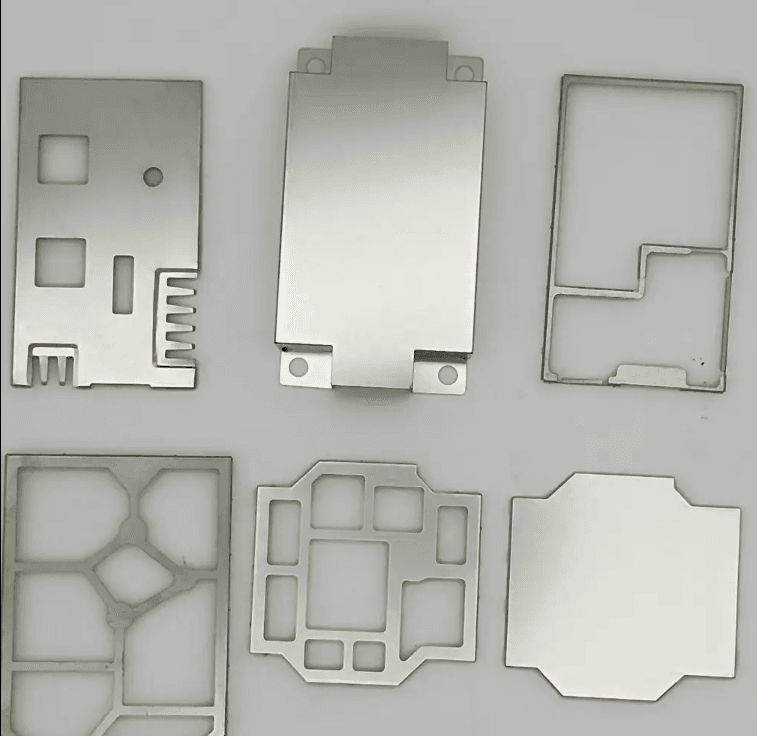
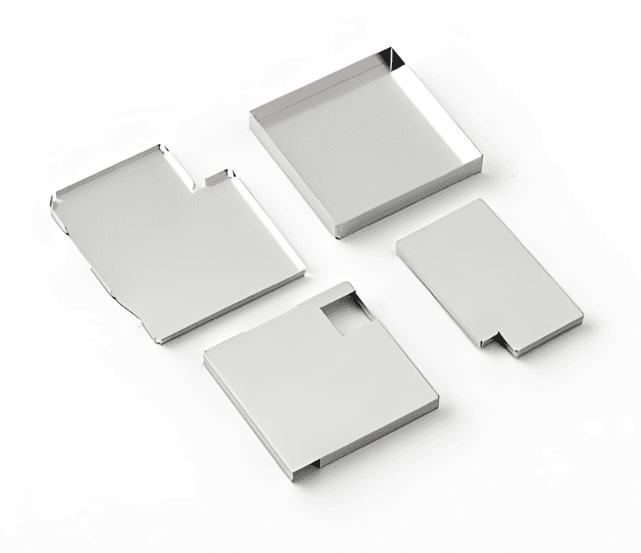
A Step Cover is a specialized EMI/RFI shielding gasket designed with multi-level profiles. Unlike flat shields, step covers feature recessed areas or varied thicknesses (the “steps”) that allow them to fit over components of different heights on a PCB or to nest into complex housing grooves.
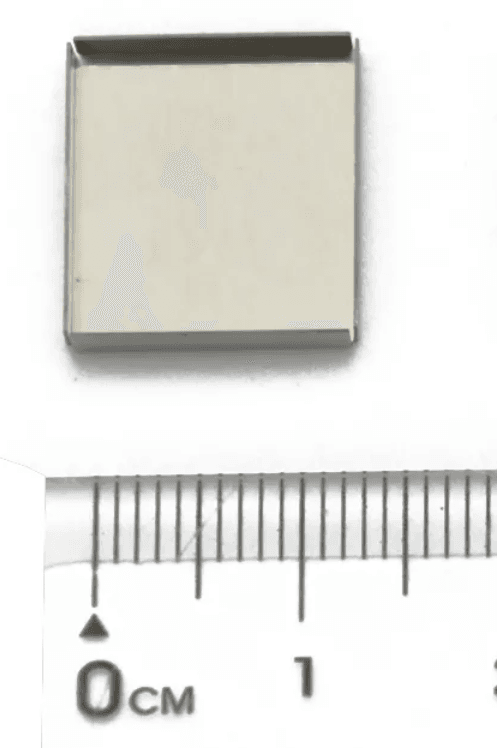
When manufactured via chemical etching, these covers are produced by selectively removing material from a titanium sheet. Because PCM is a subtractive process that uses chemical reagents rather than mechanical force, it can create “half-etched” features. These half-etched areas act as the “steps” or fold lines, allowing the cover to provide a 360-degree Faraday cage around sensitive circuitry without the need for complex multi-part assemblies.
Why Use Chemical Etching for Titanium?
Titanium is notoriously difficult to process using traditional methods. If you have ever tried to drill or mill titanium, you know it “galls”—it sticks to the tool and hardens rapidly under heat.
- Preservation of Material Properties: Titanium is prized for its biocompatibility and fatigue resistance. Chemical etching is a “cold” process; it does not introduce a Heat-Affected Zone (HAZ) or mechanical stress, ensuring the titanium’s molecular structure remains unaltered.
- Complexity Without Cost: Creating a “step” in a $0.1\text{ mm}$ thick titanium shield via CNC machining is nearly impossible and incredibly expensive. Etching allows you to etch both sides of the metal simultaneously, creating complex steps and apertures in a single process.
- Burr-Free Precision: For RFI shielding, even a tiny metal burr can act as a miniature antenna or cause a short circuit. Etching produces perfectly clean edges, ensuring a seamless metal-to-metal contact for maximum shielding effectiveness.
Process Comparison: Chemical Etching vs. CNC Machining
While CNC machining is the standard for bulk parts, it struggles with the thin-gauge requirements of EMI shielding.
| Feature | Chemical Etching (PCM) | CNC Machining |
| Minimum Thickness | $0.05\text{ mm}$ | Generally $>0.5\text{ mm}$ for stability |
| Tool Wear | None (Chemicals don’t “dull”) | High (Titanium destroys bits) |
| Design Complexity | High (Steps & holes are “free”) | Limited (Difficult to mill thin steps) |
| Surface Stress | Zero | High (Risk of warping/deflection) |
| Material Utilization | High (Tightly nested parts) | Low (Significant swarf/waste) |
Technical Data: The Gold Standard for Shielding
For high-performance gaskets, the difference between a secure seal and a “leaky” shield comes down to the numbers. Chemical etching provides the following standard specifications for titanium step covers:
- Tolerance: $\pm 0.01\text{ mm}$ (Crucial for ensuring the gasket sits flush against the housing).
- Thickness Range: $0.05\text{–}0.3\text{ mm}$ (Ideal for lightweight aerospace and portable medical applications).
- Step Depth Accuracy: Within $\pm 10\%$ of the material thickness, providing consistent EMI attenuation across the entire assembly.
Critical Applications: Where Titanium Step Covers are Essential
Because titanium is non-magnetic and highly resistant to salt spray and bodily fluids, these etched step covers are integrated into specialized high-tech equipment:
1. Next-Generation Medical Imaging (MRI & PET)
In MRI machines, powerful magnetic fields make ferrous materials (like steel) dangerous. Titanium step covers provide RFI shielding for the Signal Processing Pre-amplifiers located near the bore, ensuring that the faint signals from the human body aren’t drowned out by external noise.
2. Satellite & Space Exploration
Weight is the enemy of space flight. Titanium step covers are used in Deep Space Transponders and On-board Computer (OBC) housings. The “step” design allows for high-density component packing, while the $0.05\text{ mm}$ thickness provides maximum shielding with minimal mass.
3. Advanced Electronic Warfare (EW) Systems
In modern defense, Phased Array Radar Systems require individual shielding for each transmit/receive module. Etched titanium gaskets provide the necessary RFI isolation between channels, ensuring that high-power signals don’t interfere with sensitive receivers in the same unit.
By leveraging chemical etching, engineers can push the limits of what titanium can do—creating ultra-light, ultra-precise shields that protect the world’s most sensitive data.
Chemical etching machine