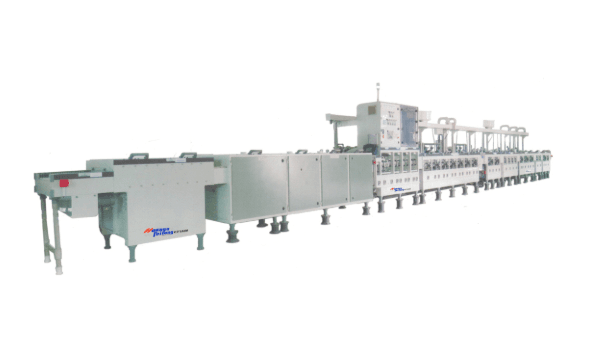
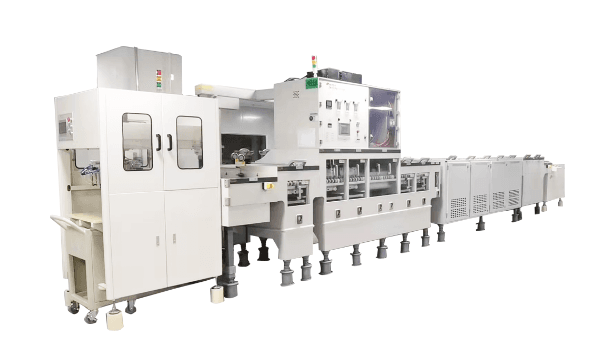
PCB Brown Oxidation Line
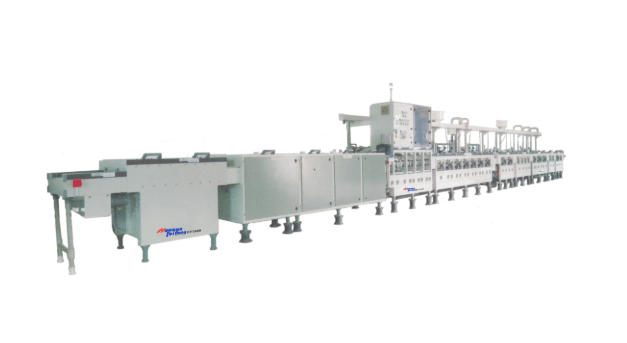
Multi-stage chemical oxidation line that converts bare copper foil into a uniformly brown-textured copper oxide surface — the standard adhesion preparation for inner-layer copper in multilayer PCB stacks. The brown oxide film is far more effective than mechanical roughening alone at securing copper-to-prepreg bond during lamination. 13.8 meters of integrated pickle, alkali wash, prepreg conditioning, browning, and rinse cascade — designed for production volume.
Why This Equipment
- Brown oxide vs. mechanical roughening — peel strength 2.5–3.5 N/mm vs. 1.5 N/mm with mechanical roughening alone.
- Five-stage chemistry sequence — pickle → alkali → condition → brown → rinse: each step does one job and does it well.
- Cooling stage before exit — panels exit at room temperature, no warping when entering lamination press.
- Fine-pitch (25 mm) rollers — supports thin flexible foil (0.075 mm) without sagging or distortion.
- Compatible with high-Tg and low-Dk prepreg — the controlled oxide morphology bonds equally to FR4, Megtron, and Rogers families.
Engineering Specifications
Where This Equipment Fits in the Production Line
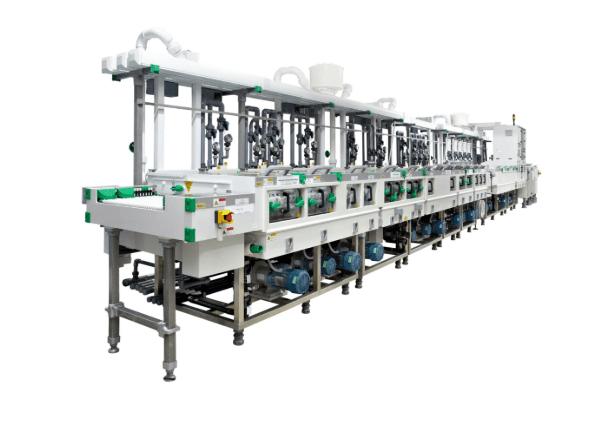
Brown oxidation is the last wet step on inner-layer PCB before lamination. Upstream is the Photoresist Stripping Machine + Chemical Cleaning Machine; downstream is the lamination press where prepreg fuses the layers. Alternative or complement to the Super Roughening Machine depending on the prepreg family.
Brown Oxide vs. Black Oxide — Why “Brown” Won
Black oxide (CuO) was the original copper-to-prepreg adhesion treatment in the 1980s but had a fatal flaw: it dissolved in the acidic plating chemistries used in subsequent through-hole plating, leading to the notorious ‘pink ring’ delamination defect. Brown oxide (a mixed Cu₂O / CuO morphology with finer crystalline structure) is acid-resistant, produces equal or better peel strength, and is now the industry standard for inner-layer treatment. Modern alternatives like ‘oxide alternative’ (OA) chemistries achieve similar results without the brown color, but brown oxide remains the most economical and best-characterized choice for high-volume production.
- Acid-stable — survives downstream through-hole plating without delaminating.
- Mixed-oxide crystal structure — anchors prepreg resin mechanically AND chemically.
- Color change is a free in-line QA check — uniform brown = uniform oxide.
Request Quote & Layout Browse Process Library Search Parameter Database
Related Equipment in This Production Line
Related Recipes & Process Parameters
Every formula and parameter row below is a live page on this site with the full chemistry, conveyor speed, and tolerance window for the exact material-thickness-etchant combination. These are the references our process engineers cite from on production shifts.
Related Material References
Related Production Applications
Related Process Equipment
Frequently Asked Questions
What peel strength can I expect?
Brown oxide on standard FR4 prepreg: 1.0–1.4 N/mm immediately after lamination, 0.8–1.1 N/mm after thermal stress (5x reflow). On high-Tg or low-Dk prepreg families, peel strength is 0.7–1.0 N/mm — still well above the 0.5 N/mm IPC-6012 minimum.
Is brown oxidation still needed if I use oxide-alternative (OA) chemistry?
Not strictly — OA chemistries achieve similar adhesion without the brown color. But OA chemistries are 2-3× more expensive per panel and require more frequent bath replacement. For high-volume production, brown oxide remains the cost leader. OA is specified for applications where the brown color interferes with downstream optical inspection.
What is the typical lead time from order to delivery?
Standard configurations: 8–12 weeks. Non-standard customizations: 12–16 weeks. Lead time includes mechanical build, electrical commissioning, bath chemistry validation on our pilot line, and packaged shipment.
Can I see this machine running before I buy?
Yes. We are not only an equipment manufacturer but also operate our own etching factory. Customers are welcome to visit Shenzhen for a live machine demonstration on the same chemistry they intend to run in production.
Frequently Asked Questions
What level of automation does the PCB Chemical Brown Oxidation Line offer?
How is throughput determined for the PCB Chemical Brown Oxidation Line?
What facility connections does the PCB Chemical Brown Oxidation Line need?
What materials is the PCB Chemical Brown Oxidation Line suitable for?
Sources & References
- IPC-A-600: Acceptability of Printed Boards
- IPC-6012: Qualification and Performance Specification for Rigid Printed Boards
- Photo Chemical Machining Institute — process capability guidelines
- NIST Engineering Statistics Handbook — process tolerance and capability
Standards are referenced for context. Always confirm parameters against the current published edition and your own process validation.