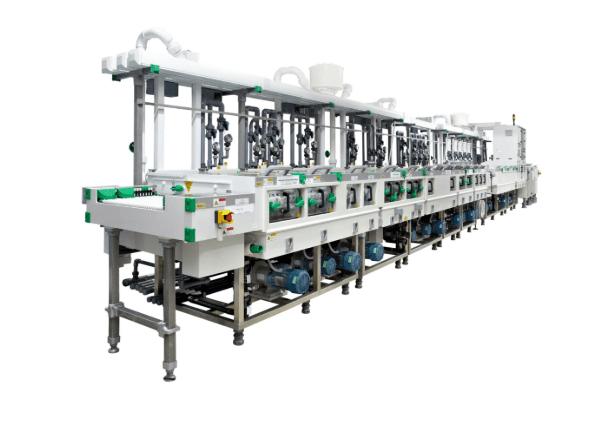
PCB OSP Machine — Organic Solderability Preservative Line
Final surface-finishing line that deposits an Organic Solderability Preservative film on exposed copper pads, protecting them from oxidation during storage and the reflow steps that follow PCB assembly. OSP is the lead-free, halogen-free, environmentally-friendly alternative to HASL and ENIG finishes — cheaper, faster, and compatible with the same SMT soldering profiles. 9.9 m line length and 38 kW rated power make this the lowest-utility-cost surface finish in production PCB.
Why This Equipment
- Lead-free, halogen-free, low-emission — meets RoHS and REACH directives without compromise.
- Compatible with standard SMT reflow profiles — drop-in replacement for HASL on standard PCB designs.
- Lowest total cost of ownership among PCB finishes — no gold consumption, no high-temp solder pot.
- Strong-wind drying before OSP coating — eliminates water spots that would cause uneven film thickness.
- Imidazole or benzotriazole chemistry selectable — match the chemistry to your downstream solder paste family.
Engineering Specifications
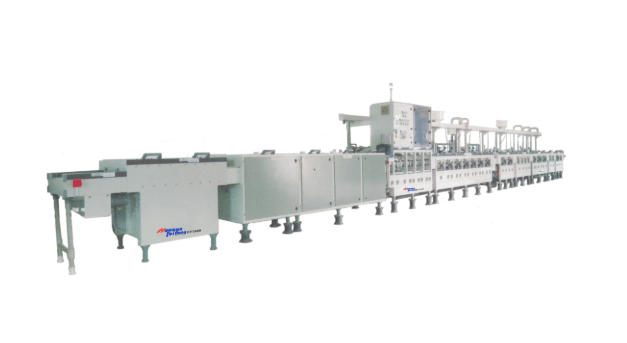
Where This Equipment Fits in the Production Line
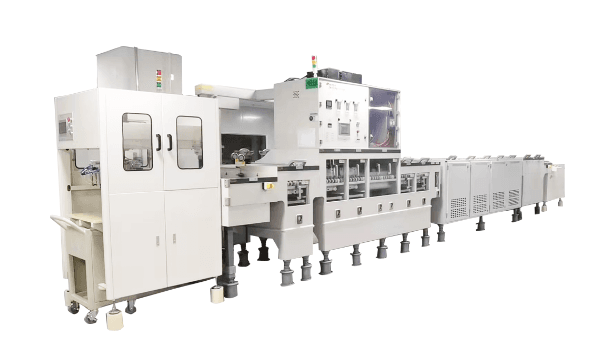
OSP is the FINAL surface finish on PCB before SMT assembly. Upstream is the Super Roughening Machine (for multilayer boards) or the Chemical Cleaning Machine (for single/double-sided). Downstream is pick-and-place SMT assembly and reflow soldering.
OSP vs. HASL vs. ENIG — Quick Engineering Decision Guide
OSP is one of three production PCB surface finishes. Picking the right one is a cost / performance / lead-time trade-off:
- OSP — lowest cost, lead-free, flat coplanar surface ideal for fine-pitch BGA. Drawback: limited shelf life (~6 months), single-reflow-only on some chemistries.
- HASL (Hot Air Solder Leveling) — traditional, robust, long shelf life. Drawback: not coplanar (bad for fine-pitch), high-energy process (high CO₂), leaded variants increasingly restricted.
- ENIG (Electroless Nickel / Immersion Gold) — flat, long shelf life, multi-reflow capable, wire-bondable. Drawback: 3–5× the cost of OSP; risk of ‘black pad’ if nickel bath drifts.
- For consumer electronics PCB at high volume with fast turn: OSP wins. For mil/aero / wire-bond / multi-reflow: ENIG wins. For low-cost low-volume legacy designs: HASL still ships.
Request Quote & Layout Browse Process Library Search Parameter Database
Related Equipment in This Production Line
Related Recipes & Process Parameters
Every formula and parameter row below is a live page on this site with the full chemistry, conveyor speed, and tolerance window for the exact material-thickness-etchant combination. These are the references our process engineers cite from on production shifts.
Related Material References
Related Production Applications
Related Process Equipment
Frequently Asked Questions
What is the shelf life of an OSP-finished board?
Industry-standard OSP chemistries are rated for 6 months at 25 °C / 50% RH in original packaging. High-performance OSP variants can extend that to 12 months, at a moderate chemistry cost premium.
What is the typical lead time from order to delivery?
Standard configurations: 8–12 weeks. Non-standard customizations: 12–16 weeks. Lead time includes mechanical build, electrical commissioning, bath chemistry validation on our pilot line, and packaged shipment.
What is included in commissioning?
On-site installation supervision by our engineering team, full mechanical and electrical commissioning, recipe loading and validation against three reference panel formats, operator training (typically 3–5 days), and one year of remote process support.
Is the machine customized to my production line?
Yes. Every system is built around your panel size, throughput target, available utilities, and downstream process integration. Standard dimensions in the spec table are the most-ordered configurations, but length, width, and bath sequence are all configurable.
Frequently Asked Questions
How is throughput determined for the PCB Chemical OSP Machine (Organic Solderability Preservative)?
What does the PCB Chemical OSP Machine (Organic Solderability Preservative) do in the production line?
What level of automation does the PCB Chemical OSP Machine (Organic Solderability Preservative) offer?
What facility connections does the PCB Chemical OSP Machine (Organic Solderability Preservative) need?
Sources & References
- IPC-A-600: Acceptability of Printed Boards
- IPC-6012: Qualification and Performance Specification for Rigid Printed Boards
- Photo Chemical Machining Institute — process capability guidelines
- NIST Engineering Statistics Handbook — process tolerance and capability
Standards are referenced for context. Always confirm parameters against the current published edition and your own process validation.