
Metal & PCB Photoresist Developing Machine
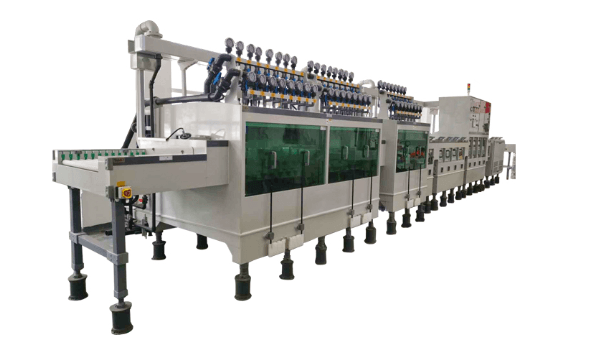
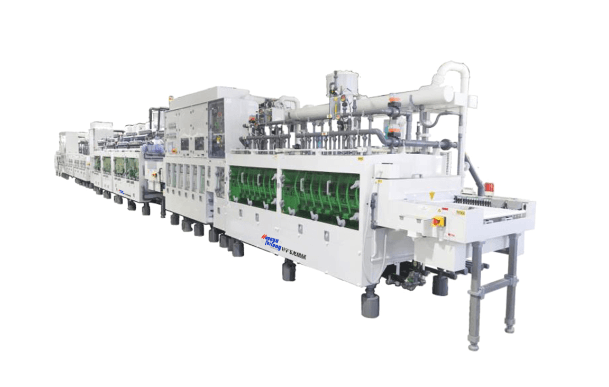
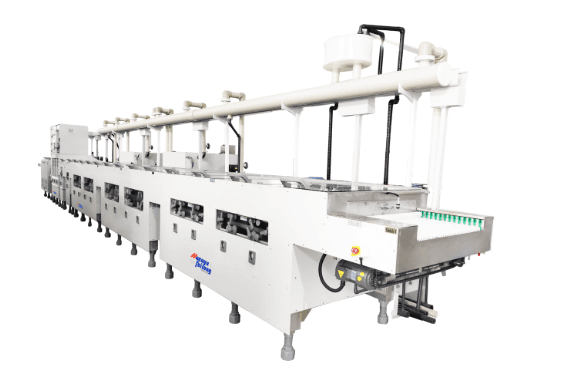
Conveyorized photoresist developing machine for both dry-film and liquid-resist lithography. Two sequential development sprays remove unexposed resist while a fresh-liquid wash rinses developer carry-over before the panel enters three cascaded overflow rinses. Air-knife “strong wind” drying delivers a dry, patterned panel ready for the etcher without operator handling.
Why This Equipment
- Two-stage development — first stage removes the bulk of unexposed resist; the second stage finishes residue clearance for clean undercut-free edges.
- Fresh-liquid wash between development and rinse — stops developer carry-over from contaminating the rinse cascade.
- Three-stage overflow rinse cascade — sodium carbonate residue scrubbed to deionized-water levels before drying.
- Air-knife drying — no streaks, no spotting; the dry panel goes straight into the etcher without manual towelling.
- Compatible with dry-film and aqueous-developable liquid resist — recipe per material stored on the HMI.
Engineering Specifications
Where This Equipment Fits in the Production Line
The developing machine is the FIRST wet stage in the lithography-etch-strip sequence. Upstream is UV exposure (hard tooling); downstream is the Production Spray Etching Machine or Vacuum Etching Machine. Developer quality directly determines the final etch quality — sloppy development means sloppy etched edges.
Developer Chemistry and What It Does
Most production lines run 0.8–1.2% sodium carbonate solution at 28–32 °C as the developer. It dissolves only the unexposed regions of the photoresist (the regions UV light did not crosslink), leaving the cross-linked mask intact over the metal that will survive the etch. Developer that is too weak leaves residue (subsequent etcher attacks under the mask — opens up the line widths); developer that is too aggressive undercuts the mask (bridges fail, fine features collapse). Both failures show up as yield loss on the etcher, but the root cause is in the developing machine.
- Bath SG monitored per shift — sodium carbonate concentration drifts as resist is removed.
- Bath temperature ±1 °C — developer aggressiveness is exponential in temperature.
- Conveyor speed matched to resist thickness — thicker resist needs longer dwell.
Request Quote & Layout Browse Process Library Search Parameter Database
Related Equipment in This Production Line
Related Recipes & Process Parameters
Every formula and parameter row below is a live page on this site with the full chemistry, conveyor speed, and tolerance window for the exact material-thickness-etchant combination. These are the references our process engineers cite from on production shifts.
Related Material References
Related Production Applications
Related Process Equipment
Frequently Asked Questions
What is the warranty?
Standard one-year warranty against manufacturing defects, plus lifetime maintenance support — spare parts are stocked and shipped from Shenzhen on order.
What developer chemistry is supplied?
The line ships with a sodium-carbonate working recipe but can be configured for potassium-carbonate or organic-amine developers at order time. Wetted parts are PP-grade compatible with all three.
Are CE / UL / SEMI compliance packages available?
Yes. CE, UL listing, and SEMI S2 / S8 compliance packages are engineering options. Specify at order time so wetted parts, electrical, and safety circuits are sized accordingly. Compliance documentation accompanies the equipment at delivery.
What is included in commissioning?
On-site installation supervision by our engineering team, full mechanical and electrical commissioning, recipe loading and validation against three reference panel formats, operator training (typically 3–5 days), and one year of remote process support.
Frequently Asked Questions
What workpiece sizes does the Metal & PCB Photoresist Chemical Developing Machine handle?
What lead time and support come with the Metal & PCB Photoresist Chemical Developing Machine?
What level of automation does the Metal & PCB Photoresist Chemical Developing Machine offer?
What facility connections does the Metal & PCB Photoresist Chemical Developing Machine need?
Sources & References
- IPC-A-600: Acceptability of Printed Boards
- IPC-6012: Qualification and Performance Specification for Rigid Printed Boards
- Photo Chemical Machining Institute — process capability guidelines
- NIST Engineering Statistics Handbook — process tolerance and capability
Standards are referenced for context. Always confirm parameters against the current published edition and your own process validation.