
1J79 Permalloy · FeCl₃+HCl
Chemical Etching Formula
1J79 Permalloy
with FeCl₃+HCl
Formula Summary
The table below summarizes every parameter that defines this etching formula. Values listed as ranges scale with sheet thickness across the supported band.
Why FeCl₃+HCl for 1J79 Permalloy?
On 1J79 Permalloy, the ferric chloride system attacks the alloy's oxide layer continuously while ferric ions drive dissolution. It is regenerable, compatible with standard photolithography, and produces clean burr-free edges — which is why nearly every 1J79 Permalloy etch line runs a variant of this formula.
Process Window & Bath Control
Hold the bath at 50°C with concentration 44 °Bé (specific gravity 1.410). Across the 0.01-0.3 mm thickness range, conveyor speed runs from 0.19-66.68 m/min — thinner sheets move faster, thicker sheets slower, in roughly inverse proportion to thickness. A typical mid-range setpoint is 4.37 m/min for 0.04 mm stock. Use redundant PID temperature control to hold the bath within ±1.5°C, and titrate at least once per shift.
Design Rules & Tolerances
Feature sizes scale with sheet thickness. For this formula the minimum hole diameter ranges 8-360 μm and the minimum line width ranges 100-300 μm across the 0.01-0.3 mm band, following the industry 1.2× (hole) and 1.0× (line) thickness rules. Single-side undercut ranges 1-54 μm, and the etch factor is about 2.77. Size your photomask by subtracting twice the expected undercut from each finished feature dimension.
• Minimum hole diameter range: 8-360 μm
• Minimum line width range: 100-300 μm
• Single-side undercut range: 1-54 μm
• Typical etch factor (EF): 2.77
Yield & Production Economics
Typical mass-production yield for 1J79 Permalloy in the FeCl₃+HCl system is 97.0%, within an observed range of 96.2-97.1%. The dominant yield-loss modes are photoresist pinhole defects and rinse-water contamination. Improving incoming sheet quality and photoresist coating consistency gives the highest yield-improvement leverage for this formula.
Typical Applications
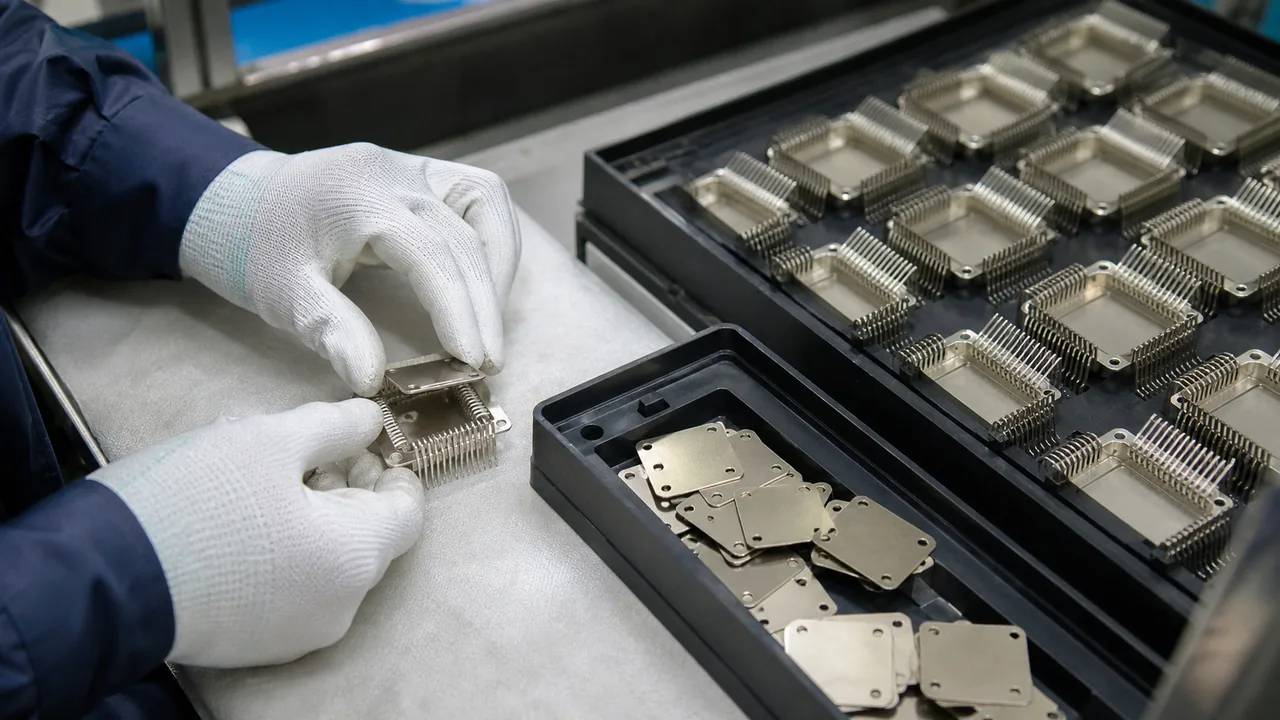
Parts produced with the FeCl₃+HCl formula on 1J79 Permalloy are common in hermetic sealing rings, lead frames matched to glass/ceramic, and magnetic shielding. The burr-free, stress-free nature of chemical etching makes it the preferred process wherever flatness and edge quality matter more than raw throughput.
Process Equipment & Material Reference
On the shop floor, this 1J79 Permalloy + FeCl₃+HCl recipe is implemented on a wet chemical etching machine. The 50°C bath setpoint and 0.19-66.68 m/min conveyor range correspond to verified production envelopes on that equipment for through etch (double-sided).
The material above is documented on this page at the recipe level. Bath chemistry, temperature, and conveyor speed are the controlling variables for repeatable output.
Production Use Cases for This Formula
Production examples for the 1J79 Permalloy / FeCl₃+HCl recipe span heat-dissipation vent etching for VC cooling, stainless steel mesh for aroma diffusers, and soy-milk-maker filtration mesh. In every case, the etch factor and undercut figures on this page are the dominant tolerance drivers — bath maintenance discipline matters more than equipment headline rating.
Designs that sit slightly outside this thickness or feature-size envelope are usually addressable by a sister formula in the same etchant family. The bath chemistry stays the same; the tuning shifts to conveyor speed and resist choice.
More Precision Alloys Formulas
Other formulas in the same material family.
Frequently Asked Questions
Sources & References
- ASTM E407: Standard Practice for Microetching Metals and Alloys
- ASTM B912: Standard Specification for Passivation of Stainless Steels
- Photo Chemical Machining Institute — process capability guidelines
- NIST Engineering Statistics Handbook — process tolerance and capability
Standards are referenced for context. Always confirm parameters against the current published edition and your own process validation.
Need a Quote for This Process?
WET Etched runs production wet chemical etching lines using the FeCl₃+HCl chemistry. Send us your part drawing and quantity for a full process quote.