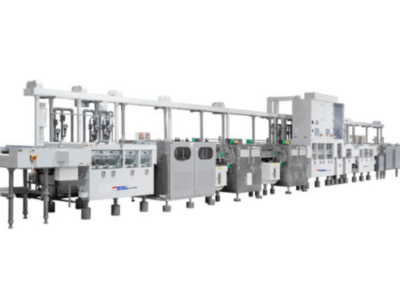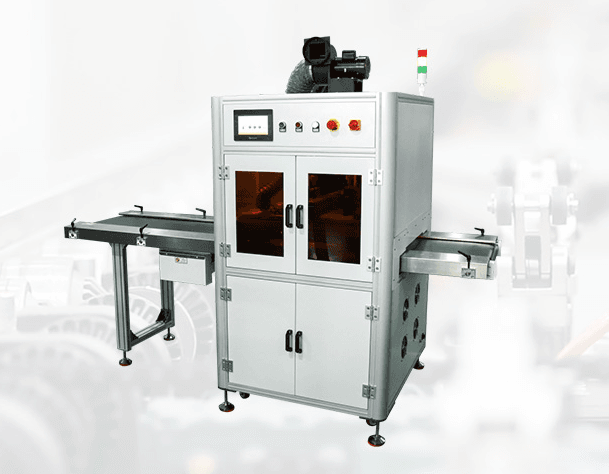
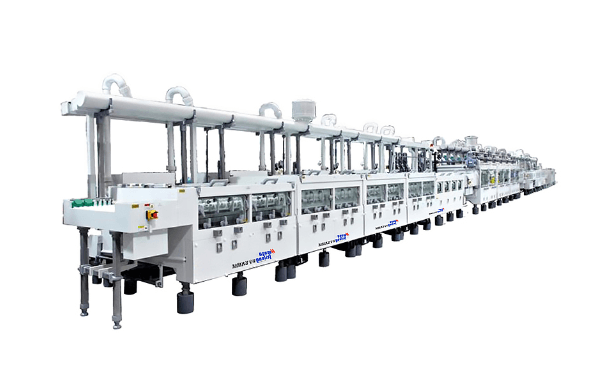
SES Line — Strip / Etch / Strip Integrated Production Line
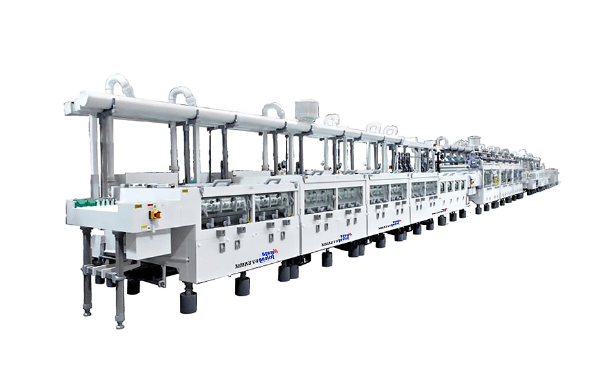
Fully integrated 32-meter production line that performs photoresist stripping, compensation etching, and tin stripping in a single conveyorized pass. The SES cell is built for inner-layer PCB and metal panel finishing where the workflow is “strip the etch mask → compensate-etch any remaining metal → strip the tin protect mask” — a three-step sequence that, if run as three separate machines, requires twice the floor space and three operator interventions per panel. Rated at 189 kW with HF compatibility and ultrasonic rinse.
Why This Equipment
- Three production steps integrated into one conveyor pass — strip → compensation etch → tin strip executed without operator handling between stages.
- HF-compatible wetted parts with ultrasonic agitation — clears micro-bridges and residue that simple spray rinse misses.
- Compensation etching built in — final tolerance correction step recovers panels that are slightly under-etched after primary etch.
- Inspection station mid-line — operator can pull a panel before it commits to tin stripping if compensation etch results are off-spec.
- Six-stage post-tin-strip rinse cascade — tin and tin-stripper residue washed below limit-of-detection before exit.
Engineering Specifications
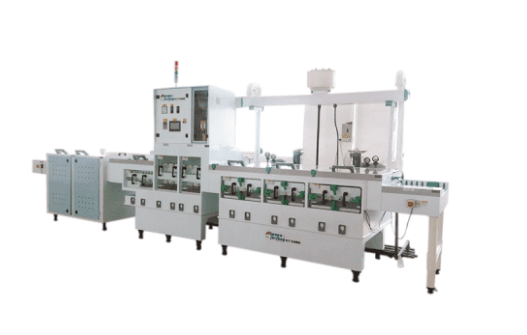
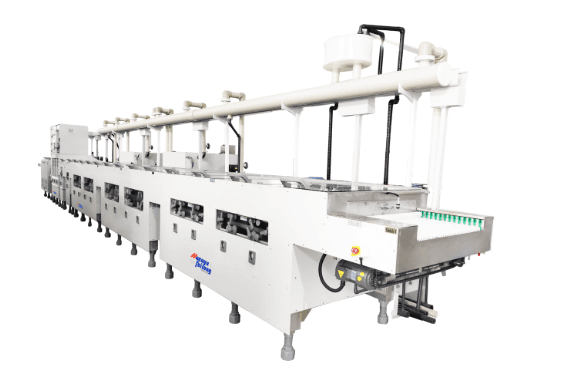
Where This Equipment Fits in the Production Line
SES is a self-contained inner-layer PCB / advanced metal-etching finishing line. It replaces a sequence of standalone Photoresist Stripping Machine, Production Spray Etching Machine, and Tin Stripping Machine where the application requires compensation etching between the two strip stages. Most commonly deployed for high-density PCB inner layers and precision lead frames.
What “Compensation Etching” Means and Why It Matters
After the photoresist strip, the panel still carries thin transitional metal at the resist edges — regions where the etchant could not fully reach during the primary etch because the resist mask was in the way. Compensation etching is a brief, low-aggressiveness etch pass that removes those transitional regions cleanly. Without it, line widths come out 5–15 μm wider than artwork. With it, the finished line is within ±5 μm of artwork. For inner-layer PCB work where impedance tolerance depends on line-width accuracy, that’s the difference between a pass and a scrap.
- Brief (typically 15–30 second dwell), low-SG etch bath — controlled removal of transitional metal.
- Held between the two photoresist-strip stages so the panel can be inspected mid-line.
- Bath chemistry typically a mild FeCl₃ or alkaline ammonia copper etchant tuned to ~0.5 µm/sec.
Request Quote & Layout Browse Process Library Search Parameter Database
Related Equipment in This Production Line
Related Recipes & Process Parameters
Every formula and parameter row below is a live page on this site with the full chemistry, conveyor speed, and tolerance window for the exact material-thickness-etchant combination. These are the references our process engineers cite from on production shifts.
Related Material References
Related Production Applications
Related Process Equipment
Frequently Asked Questions
Can the SES line be run without compensation etch?
Yes — the compensation etch stage can be bypassed at the HMI for parts where artwork compensation has already been applied at the photomask stage. Most PCB shops keep it on; most metal-etching shops keep it off.
What is included in commissioning?
On-site installation supervision by our engineering team, full mechanical and electrical commissioning, recipe loading and validation against three reference panel formats, operator training (typically 3–5 days), and one year of remote process support.
Is the machine customized to my production line?
Yes. Every system is built around your panel size, throughput target, available utilities, and downstream process integration. Standard dimensions in the spec table are the most-ordered configurations, but length, width, and bath sequence are all configurable.
Are CE / UL / SEMI compliance packages available?
Yes. CE, UL listing, and SEMI S2 / S8 compliance packages are engineering options. Specify at order time so wetted parts, electrical, and safety circuits are sized accordingly. Compliance documentation accompanies the equipment at delivery.
Frequently Asked Questions
What workpiece sizes does the Chemical SES Line (Strip-Etch-Strip) handle?
Can the Chemical SES Line (Strip-Etch-Strip) be customised for our process?
How is throughput determined for the Chemical SES Line (Strip-Etch-Strip)?
What facility connections does the Chemical SES Line (Strip-Etch-Strip) need?
Sources & References
- ASTM E407: Standard Practice for Microetching Metals and Alloys
- ASTM B912: Standard Specification for Passivation of Stainless Steels
- Photo Chemical Machining Institute — process capability guidelines
- NIST Engineering Statistics Handbook — process tolerance and capability
Standards are referenced for context. Always confirm parameters against the current published edition and your own process validation.