
Metal & PCB Vacuum Etching Machine
Long-format vacuum-assisted etching machine for ultra-thin metal foil and fine-feature PCB work. The vacuum suction beneath the conveyor pulls spent etchant and bubbles off the bottom face of the panel as fast as they form, eliminating the puddling and bubble-blocking that plague spray-only lines on sheet stock below 0.15 mm. At 13.9 meters in length with three sequential vacuum-etch stages, throughput is held high while etch factor stays above 2.8 even on tight features.
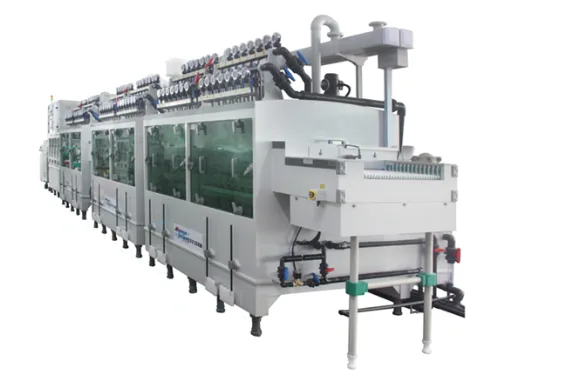
Why This Equipment
- Vacuum-assisted bottom-face evacuation — fresh etchant continuously contacts the metal, no stagnant puddles, no bubble traps.
- Three sequential etch stages — graduated chemistry / temperature per stage tunes etch factor without overshooting on thin stock.
- Optimized for ≤ 0.15 mm foil — where conventional spray-only lines lose uniformity, this platform keeps EF above 2.8.
- Higher conveyor speed (up to 7 m/min) — throughput uplift of 30–40% vs. equivalent single-stage spray lines on the same recipe.
- Industrial PLC + per-stage recipe storage — switch from “thin foil mode” to “medium-gauge mode” without re-titration.
Engineering Specifications
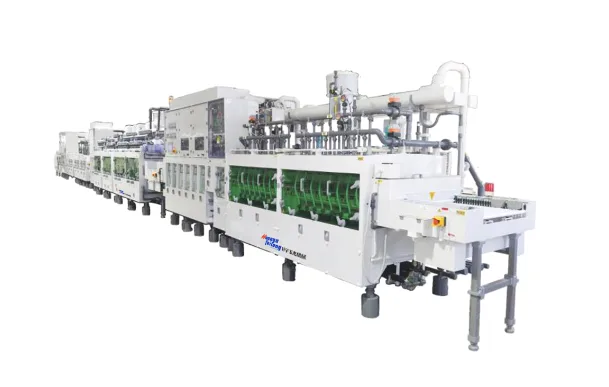
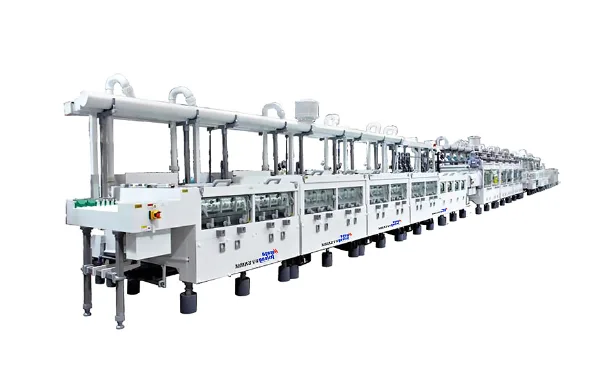
Where This Equipment Fits in the Production Line
The vacuum etching machine is the production etch cell for thin-gauge work — lead frames, foil shims, EMI shielding mesh. It pairs upstream with the Developing Machine and downstream with the Tin Stripping or Photoresist Stripping Machine.
Why “Vacuum” in a Wet Etching Machine?
In a conventional horizontal spray etcher, the bottom face of the panel is sprayed but the etchant has to drain by gravity — which leaves transient puddles in the few seconds it takes to clear. On thin foil (≤ 0.15 mm), those puddles produce non-uniform etch depth: regions that drain faster see fresh etchant sooner. Vacuum-assisted lines pull the spent etchant off the bottom face by suction through the conveyor surface, holding fresh chemistry in contact uniformly. The result is etch factor stability across the entire panel area, and the ability to push conveyor speed harder without losing tolerance.
- Bottom-face puddle elimination — uniform fresh-etchant exposure across the panel.
- Bubble extraction — no gas trapping in fine holes that would stop etch progress locally.
- Higher achievable conveyor speed at the same etch factor target.
Request Quote & Layout Browse Process Library Search Parameter Database
Related Equipment in This Production Line
Related Recipes & Process Parameters
Every formula and parameter row below is a live page on this site with the full chemistry, conveyor speed, and tolerance window for the exact material-thickness-etchant combination. These are the references our process engineers cite from on production shifts.
Related Material References
Related Production Applications
Related Process Equipment
Frequently Asked Questions
What is the typical lead time from order to delivery?
Standard configurations: 8–12 weeks. Non-standard customizations: 12–16 weeks. Lead time includes mechanical build, electrical commissioning, bath chemistry validation on our pilot line, and packaged shipment.
What is included in commissioning?
On-site installation supervision by our engineering team, full mechanical and electrical commissioning, recipe loading and validation against three reference panel formats, operator training (typically 3–5 days), and one year of remote process support.
Are CE / UL / SEMI compliance packages available?
Yes. CE, UL listing, and SEMI S2 / S8 compliance packages are engineering options. Specify at order time so wetted parts, electrical, and safety circuits are sized accordingly. Compliance documentation accompanies the equipment at delivery.
What is the warranty?
Standard one-year warranty against manufacturing defects, plus lifetime maintenance support — spare parts are stocked and shipped from Shenzhen on order.
Frequently Asked Questions
What materials is the Metal & PCB Vacuum Chemical Etching Machine suitable for?
What level of automation does the Metal & PCB Vacuum Chemical Etching Machine offer?
What workpiece sizes does the Metal & PCB Vacuum Chemical Etching Machine handle?
What facility connections does the Metal & PCB Vacuum Chemical Etching Machine need?
Sources & References
- IPC-A-600: Acceptability of Printed Boards
- IPC-6012: Qualification and Performance Specification for Rigid Printed Boards
- Photo Chemical Machining Institute — process capability guidelines
- NIST Engineering Statistics Handbook — process tolerance and capability
Standards are referenced for context. Always confirm parameters against the current published edition and your own process validation.