
TA3 commercially pure titanium · HF(5%)+HNO₃(30%)
Chemical Etching Formula
TA3 commercially pure titanium
with HF(5%)+HNO₃(30%)
Formula Summary
The table below summarizes every parameter that defines this etching formula. Values listed as ranges scale with sheet thickness across the supported band.
Why HF(5%)+HNO₃(30%) for TA3 commercially pure titanium?
Hydrofluoric/nitric formulas are used for refractory and titanium-family metals such as TA3 commercially pure titanium because the fluoride ion is one of the few species that will break down their tenacious passive oxide. The nitric component oxidizes the freshly exposed metal so the fluoride can keep working. Handling demands are high, but for TA3 commercially pure titanium there is rarely a practical alternative.
Process Window & Bath Control
Hold the bath at 34°C with concentration as specified (specific gravity 1.180). Across the 0.05-0.5 mm thickness range, conveyor speed runs from 0.12-1.36 m/min — thinner sheets move faster, thicker sheets slower, in roughly inverse proportion to thickness. A typical mid-range setpoint is 0.17 m/min for 0.18 mm stock. Use redundant PID temperature control to hold the bath within ±1.5°C, and titrate at least once per shift.
Design Rules & Tolerances
Feature sizes scale with sheet thickness. For this formula the minimum hole diameter ranges 60-600 μm and the minimum line width ranges 100-500 μm across the 0.05-0.5 mm band, following the industry 1.2× (hole) and 1.0× (line) thickness rules. Single-side undercut ranges 11-108 μm, and the etch factor is about 2.32. Size your photomask by subtracting twice the expected undercut from each finished feature dimension.
• Minimum hole diameter range: 60-600 μm
• Minimum line width range: 100-500 μm
• Single-side undercut range: 11-108 μm
• Typical etch factor (EF): 2.32
Yield & Production Economics
This formula delivers a typical yield of 95.1% (range 94.2-95.4%). At that rate, per-part economics are driven mostly by fixed photomask and setup cost for small batches and by sheet utilisation for large runs. The chemistry itself does not change with quantity, so the same recipe serves prototype and production volumes.
Typical Applications
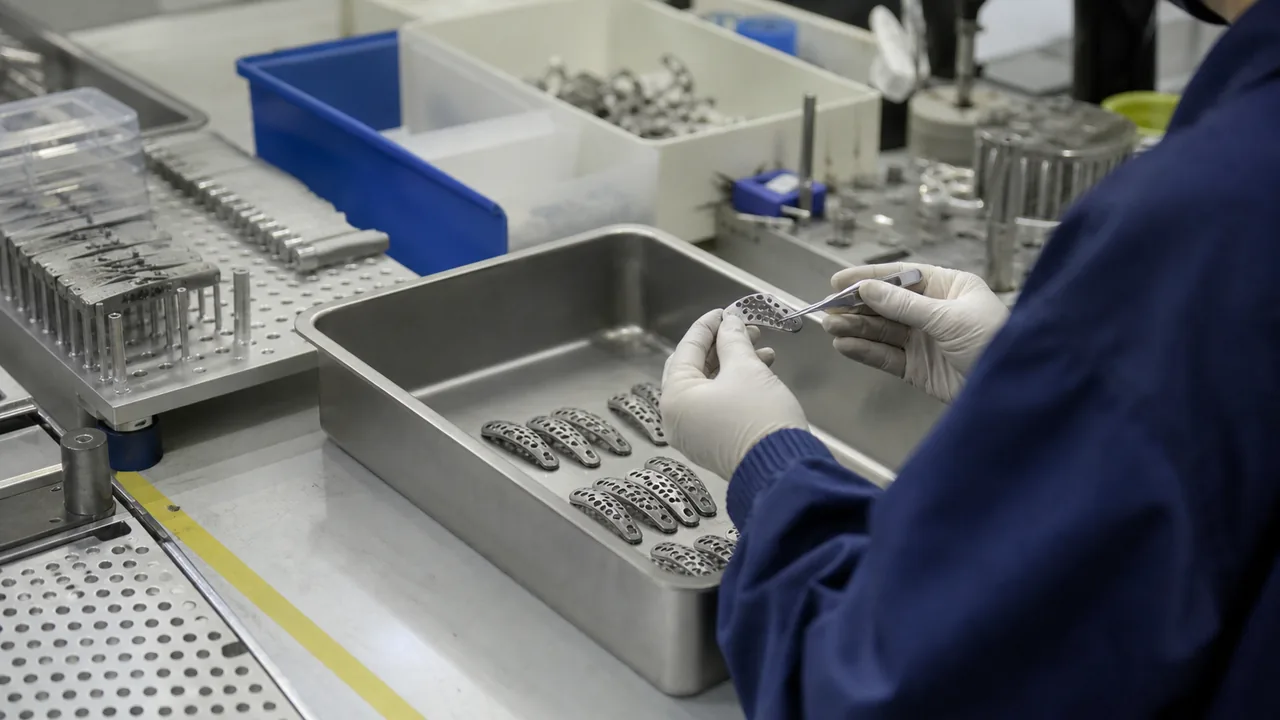
TA3 commercially pure titanium etched with this recipe typically ends up in medical implants, surgical instruments, aerospace brackets, and corrosion-resistant filters. Because chemical etching applies no mechanical or thermal load, the finished features are free of work-hardening and heat-affected zones — a decisive advantage over stamping or laser cutting for these uses.
Process Equipment & Material Reference
This TA3 commercially pure titanium formula is part of the standard process library running on our wet chemical etching machine. The same chemistry can be ported to any horizontal spray-etching line of comparable nozzle layout and bath-titration discipline.
For a broader treatment of the material itself — alloy variants, surface preparation, and process limits across thickness ranges — see our Titanium chemical etching guide. That overview complements the formula-specific bath and conveyor data on this page.
Production Use Cases for This Formula
Parts produced with this TA3 commercially pure titanium + HF(5%)+HNO₃(30%) formula end up in a wide range of finished products. Representative production runs we have completed using this exact recipe family include stainless steel metal filter mesh, high-speed air-intake mesh for hair dryers, and soy-milk-maker filtration mesh. Each case shares the same root sensitivity: clean photoresist edges, a tightly held bath SG of 1.180, and a conveyor speed inside the 0.12-1.36 m/min envelope.
Designs that sit slightly outside this thickness or feature-size envelope are usually addressable by a sister formula in the same etchant family. The bath chemistry stays the same; the tuning shifts to conveyor speed and resist choice.
More Titanium Alloys Formulas
Other formulas in the same material family.
Frequently Asked Questions
Sources & References
- ASTM E407: Standard Practice for Microetching Metals and Alloys
- ASTM B912: Standard Specification for Passivation of Stainless Steels
- Photo Chemical Machining Institute — process capability guidelines
- NIST Engineering Statistics Handbook — process tolerance and capability
Standards are referenced for context. Always confirm parameters against the current published edition and your own process validation.
Need a Quote for This Process?
WET Etched runs production wet chemical etching lines using the HF(5%)+HNO₃(30%) chemistry. Send us your part drawing and quantity for a full process quote.